Analysis, 4 min read
Carriers bet on the Houthis' target list, then switch off their transponders
Container lines are returning to Suez on the strength of a declared ban on Saudi shipping. Almost none of them will be identified on the way through Bab el-Mandeb.
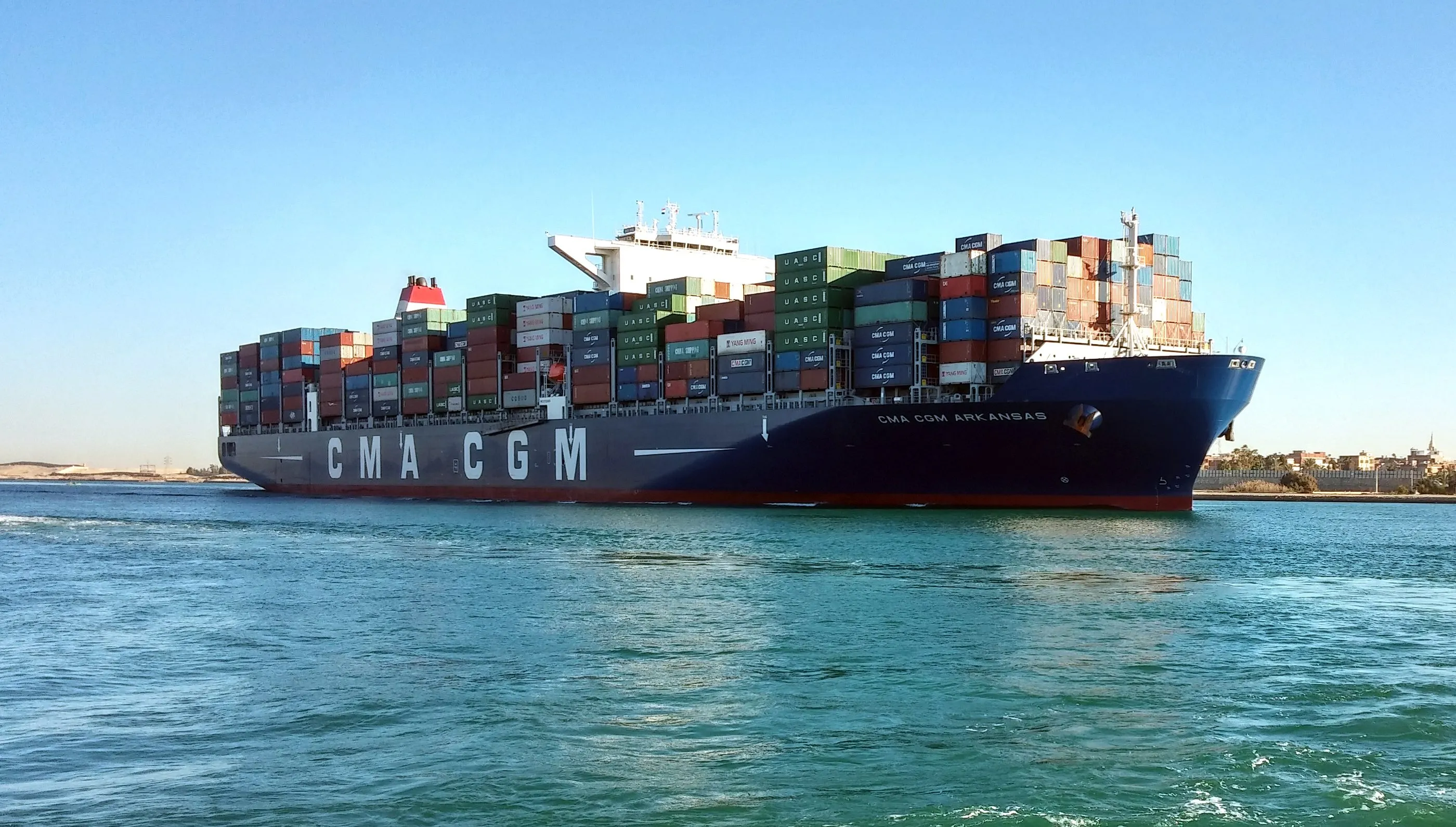
Container ship CMA CGM Arkansas in the Suez Canal, January 2016. Ahmed Helal, CC BY 2.0.
Update, 14 October 2026: In early October Yemen’s internationally recognised government launched what Bloomberg called “a full-scale military campaign to recapture Houthi-held territory”. By 13 October, Reuters reported, it had pushed the Houthis off the area closest to the strait, though they remain nearby. The Houthis have attacked Riyadh’s main airport. The carriers are still coming back: Freightos reported on 6 October that the Premier Alliance and MSC will resume some Red Sea transits this month.
Transits broadcasting AIS, threatened owners 10 of 215, since March . WindwardContainer lines are coming back to the Red Sea while the Houthis say they are firing only on Saudi shipping, and insurers have priced that promise. The carriers’ own behaviour says they do not fully believe it. Of 215 Bab el-Mandeb transits since March by shipowners the Houthis once threatened, Windward counts 10 that broadcast their position.
What happened
The Houthis declared their ban on Saudi-linked shipping in July. On 24 August they hit the Bahri tanker Amzan west of Yanbu with a ballistic missile, calling it part of a “decision to ban maritime navigation by the Saudi enemy”. Since 20 July only one Saudi-linked tanker has completed a transit of Bab el-Mandeb, according to Lloyd’s List Intelligence.
On 10 September the Houthis took the port of Mokha and, the next day, Perim, the island in the middle of Bab el-Mandeb, according to FDD’s Long War Journal. Lloyd’s List Intelligence still wrote on 18 September of “reported advances towards Perim and the Hanish islands”; by 25 September Reuters was reporting the capture of Perim as fact. The group’s front line now runs to the strait itself.
The carriers moved anyway. In mid-September Maersk and Hapag-Lloyd said four more Gemini services would return from the Cape of Good Hope to Suez, three of them with first sailings on 19, 21 and 24 September. The partners added that the changes depend on security conditions in the Red Sea.
The numbers
Suez Canal transits, August 1,358, +27% y/y . Suez Canal Authority, via Daily News EgyptThe return shows up in every count. Windward has Suez containership transits up 59% between March and September, from 139 to 221, and ships of 300 metres or more up from 22 to 127. Lloyd’s List Intelligence counted 44 ultra-large containerships through Bab el-Mandeb in 2026, against one in all of 2025. Suez Canal transits in August were 1,358, up 27% on a year earlier, and revenue was $567.1 million, up 56.7%.
Freightos Asia-N. Europe (FBX11) $3,700/FEU, -15% w/w . FreightosFreight rates fell as the capacity came back. In the week to 22 September the Freightos Asia-North Europe index dropped 15% to $3,700 per forty-foot container, and Asia-Mediterranean fell 7% to $3,900. Freightos headlined its update “Asia-Med rates back to pre-peak levels as Red Sea transits increase.”
War cover, Saudi-linked tanker at Yanbu About 3% (under 1% in July) . Reuters, via Insurance JournalInsurance shows the target list most clearly. Reuters reported on 25 September that war cover for a tanker with no Saudi link costs between 0.2% and 0.3% of the ship’s value in the Red Sea. A Saudi-linked tanker at Yanbu pays around 3%, up from less than 1% in July, and at ports further south such as Jizan as much as 7%. Hormuz cover runs at 6% to 9%.
The tracking data shows something else. Of the 215 transits since March by owners the Houthis threatened in their 2023-2025 campaign, only 10 transmitted AIS. Russian- and Iranian-owned ships, Windward notes, almost all kept their transponders on. Linerlytica found that seven MSC ships returning to Suez in August made every Bab el-Mandeb crossing dark.
Transmission
Insurers have turned the Houthi target list into a price, and the price runs into freight. A Saudi-linked tanker pays ten times or more what a non-Saudi one pays for the same water. Capacity that goes through Suez instead of around Africa is capacity added to the market. Freightos suggests that is part of why Mediterranean rates have fallen further from their July peak. Shippers gain, and so does Egypt. Saudi Arabia’s Red Sea ports, its route around Hormuz, now carry the highest war premiums in the sea.
The weak point in the carriers’ bet is that the Houthis decide what counts as Saudi. On 11 August missiles struck the Egyptian-owned cargo ship Tihama in Bab el-Mandeb. Yemeni officials said four crew and two rescuers were killed, and the government blamed the Houthis. The Houthis said later that they had attacked a Saudi ship carrying military equipment.
Valtor’s inference Our reading, and it is an inference: the dark transits are the carriers’ hedge against exactly that. They trust the target list enough to come back, and not enough to be seen. A ship that cannot easily be identified is harder to relabel.
There is a measurement cost as well. AIS is how much of the market watches the Red Sea. When 205 of 215 transits by the most exposed owners are dark, any count built on AIS undercounts the return and says little about who is crossing. The canal counts ships physically and is not affected. Most real-time trackers are.
What to watch
- A strike on a ship with no Saudi link, or a Houthi claim that gives one a Saudi link after the fact. Either would show the list is elastic, and the Cape would come back into the price.
- The insurance spread. If cover for non-Saudi ships moves from 0.2–0.3% toward the 3% charged at Yanbu, underwriters have stopped believing the list.
- The share of visible transits. If returning carriers start broadcasting AIS through Bab el-Mandeb, owners have begun to trust the selectivity they are already pricing.
Bottom line
The return to Suez is real. It is in the canal’s numbers, in the transit counts and in falling freight rates. It also rests on a target list the Houthis write and interpret themselves. The carriers have come back on that list, and almost none of them are letting the Houthis see who they are.
Figures in this piece
Those the text states in the same form also stand in the margin beside it.
- 0.2–0.3% of valueWar cover, non-Saudi tanker, Red Sea. Reuters, via Insurance Journal
- About 3% (under 1% in July)War cover, Saudi-linked tanker at Yanbu. Reuters, via Insurance Journal
- 10 of 215, since MarchTransits broadcasting AIS, threatened owners. Windward
- $3,700/FEU, -15% w/wFreightos Asia-N. Europe (FBX11). Freightos
- 1,358, +27% y/ySuez Canal transits, August. Suez Canal Authority, via Daily News Egypt
Sources
- Al Jazeera, Houthis report attack on Saudi ship, 24 August 2026
- The National, cargo vessel struck off Yemen's coast with deaths reported, 11 August 2026
- FDD's Long War Journal, Houthis take Yemen's Red Sea coast and key Bab al Mandeb islands, 14 September 2026
- Lloyd's List Intelligence, Red Sea Brief, 18 September 2026
- WorldCargoNews, Maersk and Hapag-Lloyd step up Suez routings, 15 September 2026
- Windward, Suez transits are up 59 percent, 1 October 2026
- The Loadstar, Seven MSC box ships go dark as they resume Suez Canal transits, 18 August 2026
- Freightos weekly update, 22 September 2026
- Reuters, Red Sea war insurance for Saudi-linked tankers, 25 September 2026 (via Insurance Journal)
- Daily News Egypt, Suez Canal traffic rises 27% in August, 20 September 2026
- Bloomberg, oil slides on Saudi price cut, 5 October 2026 (via Rigzone)
- Reuters, Saudi Arabia strikes Houthi targets as Red Sea war escalates, 13 October 2026 (via gCaptain)
- Freightos weekly update, Premier Alliance joins Red Sea return, 6 October 2026
Filed under Red Sea.
A number here looks wrong? Send a correction. How corrections are handled.
Get it by email
New analysis and notes, at most once a week. The address is used for nothing else, and one reply takes you off the list. Privacy notice.

_001.jpg)