Note, 3 min read
Oil is above $100 and Iraq has devalued. Its problem is barrels, not price.
Baghdad cut the dinar by about 13% on 7 October, the first devaluation by a Gulf Arab state since the war began. A price boom does little for an exporter that cannot ship.
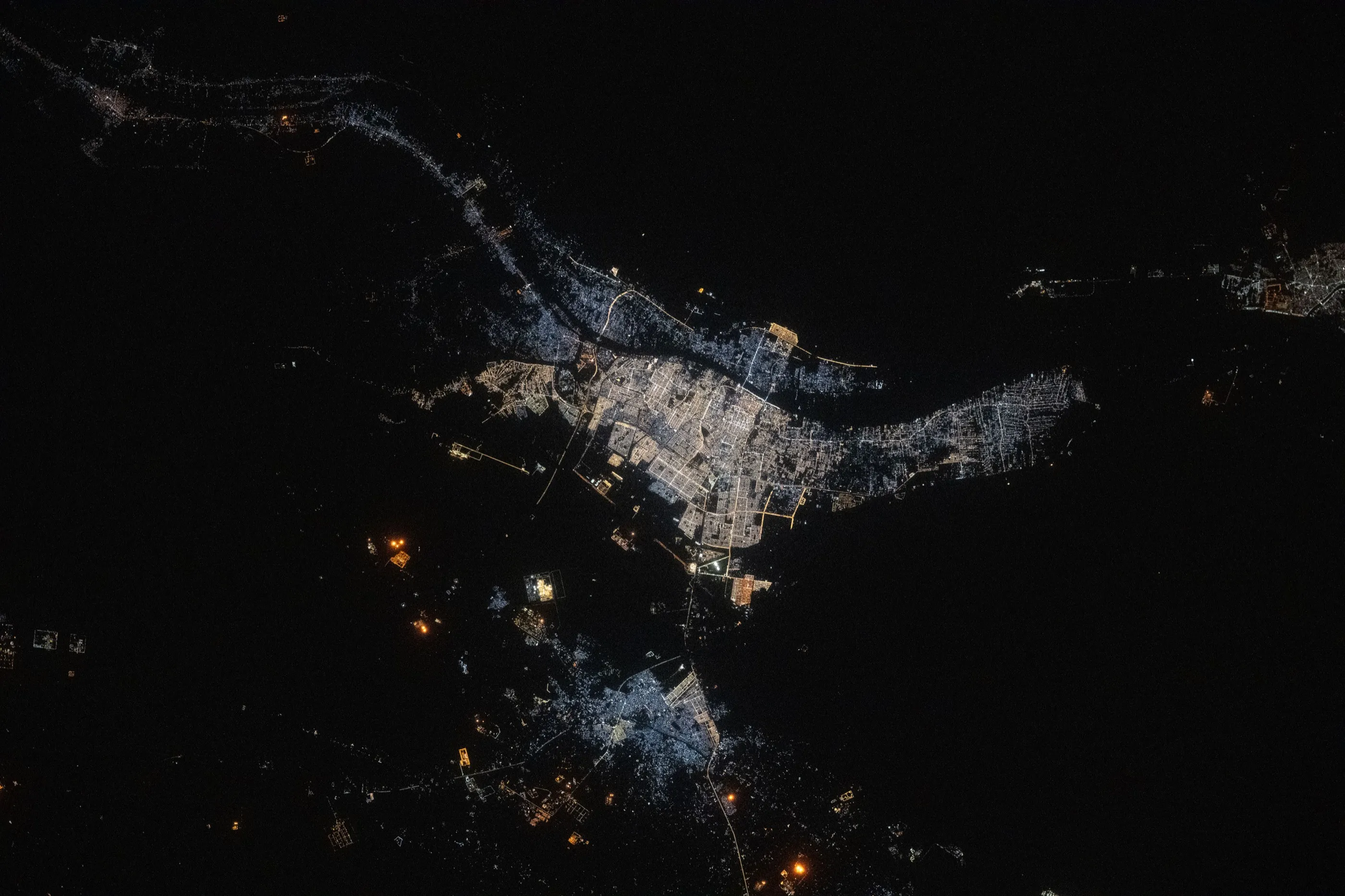
Basra, Iraq's oil port city on the Shatt al-Arab, from the International Space Station, May 2025. NASA Johnson Space Center, Public domain.
Central bank dollar selling rate 1,520 dinars (1,320 before) . Central Bank of Iraq, via AFPOn 7 October the Central Bank of Iraq set its selling price for dollars to the public at 1,520 dinars, against 1,320 before. Banks were told to “stop using the previous rate and adopt the new rate as of the start of the business day on October 7”, AFP reported. Bloomberg calls it a 13% devaluation, “the first devaluation since the start of the US-Israel war on Iran by a Gulf Arab state”. An agency report carried by the Kuwait Times puts it at “roughly 14.5 percent below the previous official rate”.
Iraqi crude exports since March, average About 1.25 mb/d (almost 3.5 mb/d in 2025) . Bloomberg estimates, via RigzoneIt came with Brent more than 70% higher this year, by Bloomberg’s count. A price boom should flatter an exporter whose oil sales are “nearly 90 percent” of state revenue. It has not, because Iraq cannot ship enough of its oil. Bloomberg estimates Iraqi crude exports have averaged “only about 1.25 million barrels a day since the start of March”, against almost 3.5 million last year. In August, exports from Iraq’s southern ports averaged 2.35 million barrels a day on Kpler’s data, Reuters reported; the agency report gives about 2.34 million for August, without naming its source, against more than 3.6 million before the war. SOMO, the state oil marketer, put losses since the conflict began at around $80 billion.
Iraq foreign-exchange reserves About $80bn in August (about $100bn pre-war) . Bloomberg, via RigzoneThe reserves paid the difference until they could not. Iraq had about $100 billion in foreign exchange when the war began and $80 billion in August, according to Bloomberg. Public-sector salaries cost about $5 billion a month. “Baghdad had to choose between paying its public-sector salaries and defending the dinar’s value — it picked the former,” said Ziad Daoud, Bloomberg’s chief emerging-market economist. An Iraqi analyst quoted in the agency report, Mohammed Al-Saffar, gave the mechanism: “It gives the government more dinars for each dollar of oil revenue, but raises import costs and reduces households’ purchasing power.”
Oil price assumed in draft budget $58/bbl, about 4 mb/d of exports . Iraqi lawmakers, via Reuters (Kuwait Times)The draft budget shows where the risk sits. Lawmakers told Reuters it assumes an oil price of $58 a barrel and crude exports of “around 4 million barrels per day”, with a deficit of more than 40 trillion dinars.
Valtor’s inference Our inference, not a claim in any source: the price assumption is the safe half of that budget and the volume assumption is the fragile half. Four million barrels a day is well above anything Iraq has shipped since March on any count above. Iraqi barrels also leave through a strait where attacks are rising: by 7 October UKMTO had reported at least nine in Hormuz in October, Bloomberg said. For an exporter in this position the exchange rate becomes the shock absorber, and households take the hit through import prices.
What to watch
- Iraq’s October loadings. If they slip back toward the 1.25 million barrel a day average after the rise in attacks, the 1,520 rate is unlikely to be the last adjustment.
- The market rate for dollars in Baghdad. None of the reports we read gives one yet. A wide gap to 1,520 would mean the new rate has not cleared the market.
- Other Gulf pegs. Bloomberg reports that Saudi Arabia, Kuwait and Qatar are also expected to contract this year. Bloomberg notes that most Gulf Arab states peg to the dollar, and Iraq’s is the first devaluation among them since the war began.
High prices do not pay an exporter for oil it cannot load. Iraq is the first Gulf state to say so with its currency.
Figures in this piece
Each also stands in the margin beside the paragraph that states it.
- 1,520 dinars (1,320 before)Central bank dollar selling rate. Central Bank of Iraq, via AFP
- About 1.25 mb/d (almost 3.5 mb/d in 2025)Iraqi crude exports since March, average. Bloomberg estimates, via Rigzone
- About $80bn in August (about $100bn pre-war)Iraq foreign-exchange reserves. Bloomberg, via Rigzone
- $58/bbl, about 4 mb/d of exportsOil price assumed in draft budget. Iraqi lawmakers, via Reuters (Kuwait Times)
Sources
- Bloomberg, Iraq devalues currency as Hormuz havoc hits oil exports, 7 October 2026 (via Rigzone)
- AFP, Iraq central bank devalues dinar after Middle East war hurts oil exports, 7 October 2026 (Oman Observer)
- Kuwait Times (agencies), Iraq central bank devalues dinar as war hurts oil exports, 7 October 2026
- Bloomberg, Brent steady amid Middle East tensions, 13 October 2026 (via Rigzone)
- Bloomberg, Oil dips as Middle East flows recover, 7 October 2026 (via Rigzone)
- Reuters, Vitol becomes Iraq's second-largest crude buyer amid its export struggles, 24 September 2026 (via Baird Maritime)
Filed under Strait of Hormuz.
A number here looks wrong? Send a correction. How corrections are handled.
Get it by email
New analysis and notes, at most once a week. The address is used for nothing else, and one reply takes you off the list. Privacy notice.


.jpg)