Note, 2 min read
Europe's gas storage hit its lowest for the season since 2009. Brussels has not said the number.
The Commission says there is no immediate risk to supply. Its case rests on LNG import capacity, which depends on the market Qatar has left.
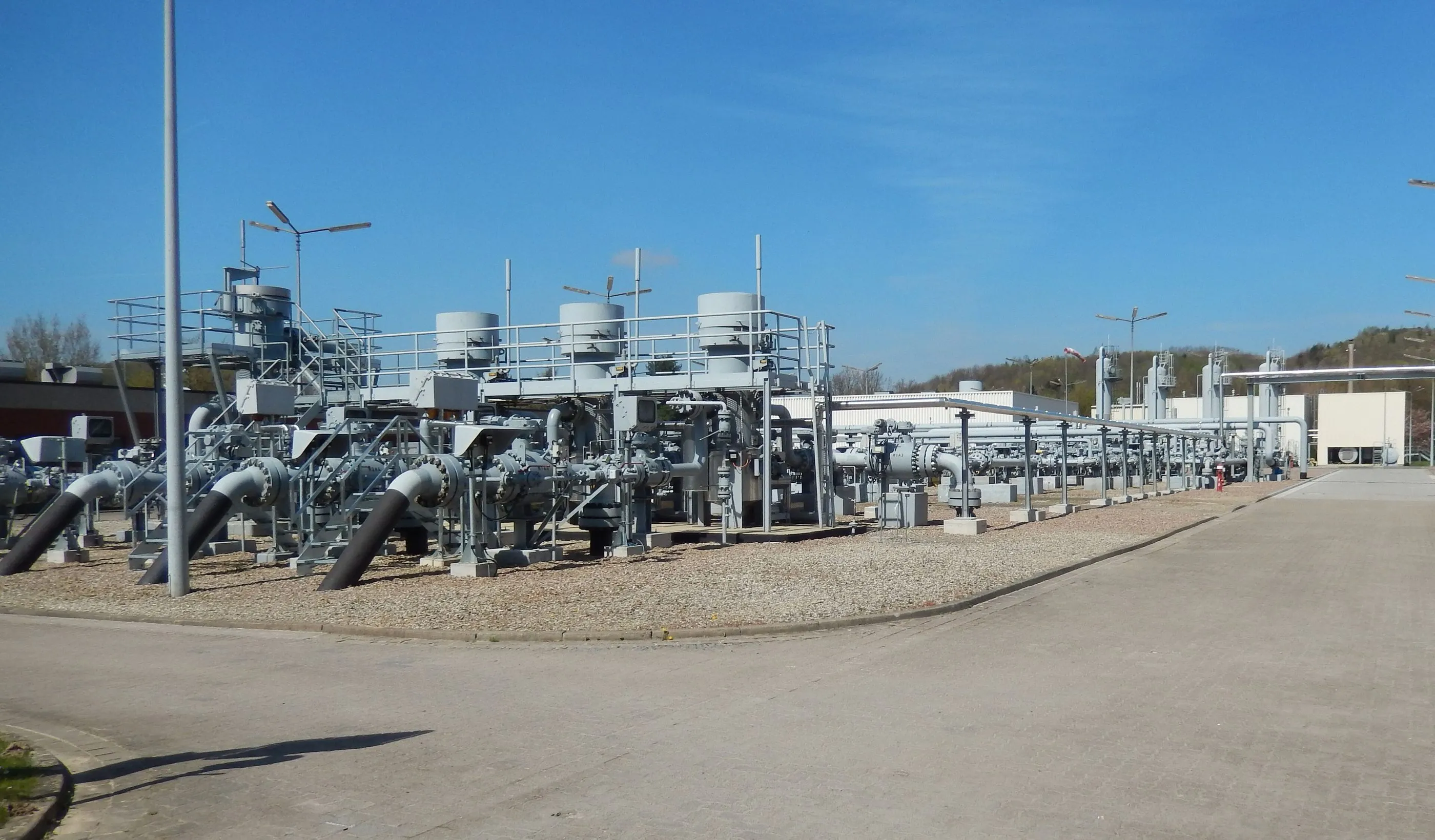
Underground gas storage at Empelde, near Hanover, Germany, April 2015. Gerd Fahrenhorst, CC BY 3.0.
Update, 14 October 2026: The Commission’s statement of 8 October, issued as ENTSOG published its Winter Supply Outlook, again gave no storage figure. EU storage reached 74.02% on 13 October in AGSI+ data, above Wood Mackenzie’s 73% end-of-summer forecast, and still lower than on that date in any year since 2011.
On 3 September the European Commission and EU member states said there was “no immediate risk for security of gas supply in the EU.” On 25 September they “reconfirmed that EU gas supply remains stable.” Both statements acknowledged lower storage. Neither gave a figure.
EU gas storage 70.89% full . GIE AGSI+Forecast storage, end of winter 21% . Wood Mackenzie, via RigzoneThe figure is 70.89%. That was the fill level of EU storage on 26 September in GIE’s AGSI+ data, roughly 16 points below the 2021-2025 average for that day. Wood Mackenzie said in early September that storage was at its lowest for the time of year since 2009, and forecasts 21% by the end of winter. With less storage to lean on, it warned, “the market’s ability to absorb shocks is materially reduced”.
The Commission’s case for calm does not rest on storage. Its 3 September statement credits “increased diversification, higher LNG import capacity, and reduced gas demand,” and concludes that “the EU gas system is resilient enough to cope with lower storage levels for the upcoming winter.” The same statement notes that “Qatari LNG production is still shut down.”
Valtor’s inference Our reading, and it is an inference: import capacity is only as useful as the cargoes available to fill it. Europe’s plan for the winter is to buy LNG in a market that has lost Qatar’s supply, in competition with Asian buyers. That may work. It is a bet on the spot market rather than a reserve, and the statements put a number on neither.
What to watch
- ENTSOG’s Winter Supply Outlook, published on 8 October, which the Commission says “confirms that the EU gas system is sufficiently flexible to meet demand this winter”.
- The storage path through October. If injections stall well short of Wood Mackenzie’s 73% end-of-summer forecast, the 21% end-of-winter figure stops looking like a floor.
“Resilient enough” may prove right. Publishing the number would let the market check.
Figures in this piece
Those the text states in the same form also stand in the margin beside it.
- 70.89% fullEU gas storage. GIE AGSI+
- 67.35% fullEU gas storage, 8 September. GIE AGSI+
- 21%Forecast storage, end of winter. Wood Mackenzie, via Rigzone
Sources
- European Commission, Gas Coordination Group: no immediate security of supply risk, 3 September 2026
- European Commission, Gas Coordination Group continues work on winter preparedness, 25 September 2026
- GIE AGSI+, EU aggregate storage, gas days 8 and 26 September and 13 October 2026
- European Commission, EU gas system prepared for the winter despite lower storage levels, 8 October 2026
- Rigzone, EU faces worst gas storage position in decades, Wood Mackenzie says, 10 September 2026
Filed under Europe.
A number here looks wrong? Send a correction. How corrections are handled.
Get it by email
New analysis and notes, at most once a week. The address is used for nothing else, and one reply takes you off the list. Privacy notice.