Analysis, 5 min read
The G7's 100 million barrels were already promised in March
The emergency release announced on 2 October is the undelivered part of the IEA's spring action, and much of it sits in Europe. The shortage it now has to fill is diesel, and Washington used the threat of an export ban to get it.
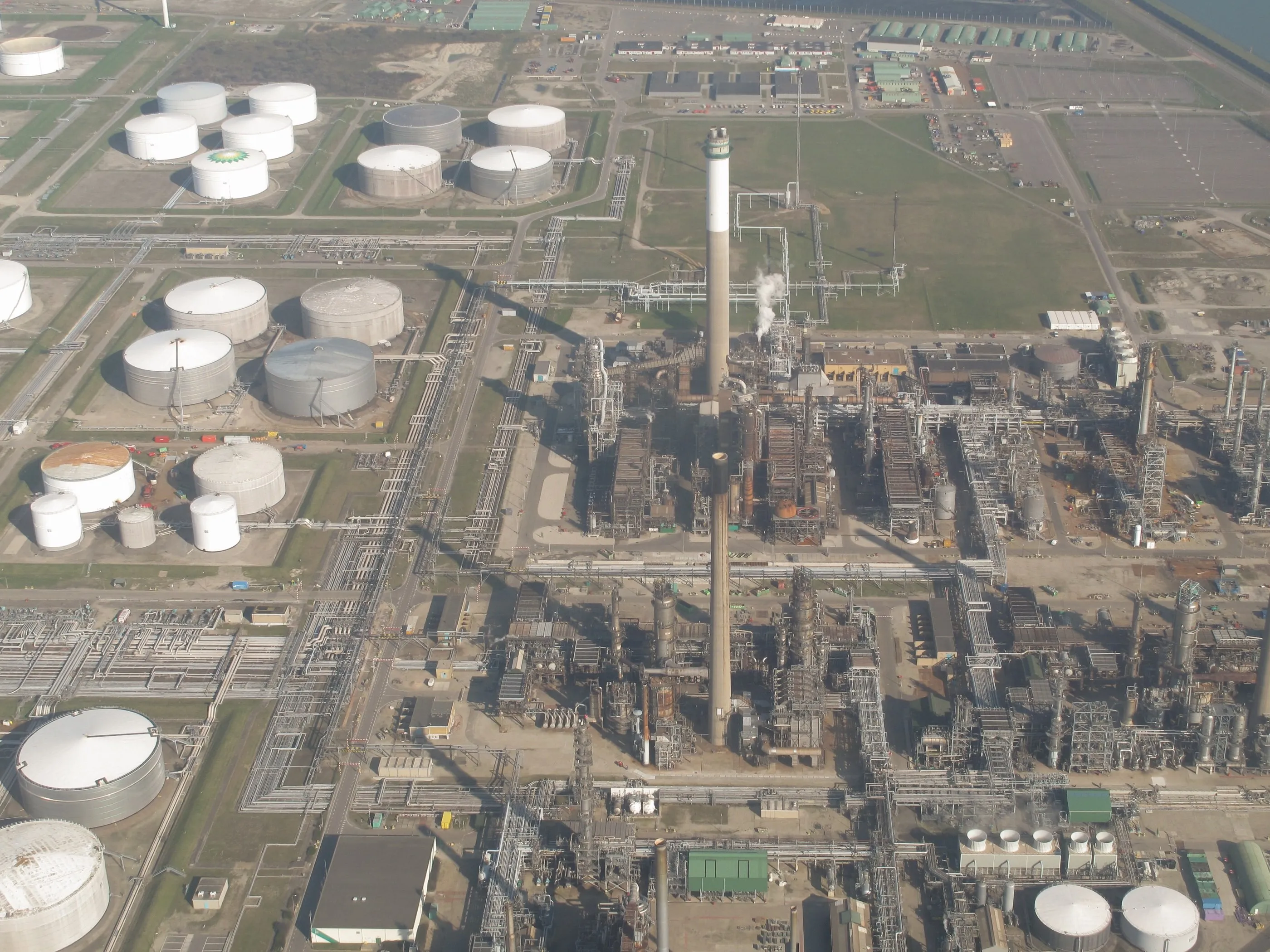
BP's refinery and tank farm at Europoort, Rotterdam, March 2014. Michielverbeek, CC BY-SA 3.0.
March pledges not yet released About 100m bbl . IEA IEA Governing Board: remaining March releases About 100m bbl, incl. over 20m bbl diesel to accelerate; 330m released . IEA On 2 October the G7 announced “a coordinated release through the IEA of 100 million barrels” of oil, diesel first. The same sentence says what the barrels are for: “we will implement our commitments”, meaning those made in March. Five days later the IEA put the volume pledged in March but not yet delivered at “approximately 100 million barrels”. Diesel prices fell on the news. On the documents’ own wording, most of it is the balance of an old promise, and the shortage it has to fill has moved from crude to diesel since that promise was made. The IEA’s Governing Board met on 15 October, and its statement fits that reading: it agreed to “complete the remaining releases of around 100 million barrels” and to speed up “over 20 million barrels of diesel”, and it named no new volume.
What happened
On 11 March the IEA’s members agreed to release 400 million barrels after the war with Iran disrupted shipping through the Strait of Hormuz. The United States has finished its share. On 29 September it approved a last tranche of 40 million barrels from its Strategic Petroleum Reserve, “completing its part of the effort”, Bloomberg reported. Energy Secretary Chris Wright said that week: “Several European member countries have released only a fraction of the crude oil and petroleum products they pledged.”
The pressure came with a threat. On 1 October Bloomberg reported a memo showing that Washington had asked “at least one member state to release inventories in order to avoid an export ban” on US diesel. Politico, as cited by Bloomberg, reported that the request was for 120 million barrels of diesel over 180 days. The G7 leaders met by video the next day. Their statement promised the 100 million barrels “over 4 months, including a frontloaded substantial diesel release within the first 20 days”, and reaffirmed a commitment “to refrain from export restrictions on energy and energy products between G7 countries”.
The numbers
The IEA’s 7 October statement says about 325 million barrels have been released, “with some countries having released greater volumes than they initially pledged”, and that releasing everything still pledged “would bring approximately 100 million barrels to the market”. That remainder matches the G7 figure. EU governments read it the same way: on 7 October Bloomberg reported that, according to a memo, EU countries were “in broad agreement” that the G7 deal “will in fact just enact previous commitments rather than requiring additional volumes”.
Bloomberg’s reporting shows where much of the remainder sits. On 1 October it reported that Germany had no plans to offer the 15 million barrels left of its pledge, “about 77% of its total contribution”. Spain had released about a third of its 11.6 million barrels. France still has a full strategic stockpile, its finance minister said. The UK, with a 14 million barrel pledge, said “significant stocks are available should the market need them.”
Public emergency stocks still held, IEA members About 1.1bn bbl, incl. over 200m bbl diesel . IEA Europe has also drawn its own fuel down far less. Data reported to the IEA and JODI, as summarised by Bloomberg, show US diesel and gasoil inventories fell 27% between February and July. In Europe’s five biggest economies the declines were “no greater than 7%”. The IEA says its members still hold public emergency stocks of “around 1.1 billion barrels, including over 200 million barrels of diesel”.
US retail diesel, September average $6.29/gal ($3.81 on 23 Feb) . EIA, Short-Term Energy Outlook; EIA weekly series via FRED Refined products crossing Hormuz, 7-day rate 677 kb/d (3.6 mb/d pre-war) . Kpler, via CNBC Demand for those barrels is in diesel. On Kpler’s count, refined products crossing Hormuz ran at 677,000 barrels a day in the week to 28 September, against 3.6 million before the war, while crude was back at its pre-war benchmark. Russia’s diesel exports fell to 144,000 barrels a day in September, a decade low in Vortexa’s data. US retail diesel averaged $6.29 a gallon in September, according to the EIA. It was $3.81 in the week of 23 February.
Transmission
Diesel fell on the announcement, then recovered part of the loss. “European diesel slumped more than 8% before paring losses” on 2 October, Bloomberg reported. New York Harbor diesel fell from $5.02 a gallon on 30 September to $4.63 on 5 October in the EIA’s series, and was back at $4.71 the next day. On 7 October European diesel futures “rose as much as 6.8%”. By 13 October New York Harbor diesel was $5.11, above where it stood before the announcement, and $5.07 the day after.
Valtor’s inference This is Valtor’s arithmetic and inference, not a claim any source makes. One hundred million barrels over four months is about 0.83 million barrels a day, crude and products together. The products shortfall through Hormuz alone was about 2.9 million barrels a day on Kpler’s late-September count. The comparison is rough, because part of the release is crude, but the scale is clear: the release eases the shortage without closing it. Its main effect may be what it bought. Europe released stocks it had held back, and the G7 reaffirmed its commitment not to restrict energy exports among its members. For Europe, which now relies on the United States as its top diesel supplier, that commitment is worth more than the barrels.
Brent spot, physical (EIA) $135.51/bbl ($114.82 a day earlier) . EIA via FRED The physical crude market did not ease. The EIA’s spot price for physical Brent rose from $114.82 on 1 October to $135.51 on 2 October, the day of the G7 statement; no report we found explains that day’s move. On 9 October Bloomberg reported that Dated Brent had “topped $135” the day before, while December futures settled above $104.
On 11 October the IEA’s executive director, Fatih Birol, asked members to assess “additional diesel releases”, setting out “their scale, timing and supplemental nature”. The Governing Board’s statement of 15 October named none. It put releases so far at “approximately 330 million barrels” and listed the “over 20 million barrels of diesel” among “the remaining volumes” to be accelerated. It noted that some members intend to release more than they pledged, “making the total amount of stocks to be released exceed the original total of 400 million barrels”. That is the only new supply in the statement, and it carries no number.
What to watch
- A number for the over-delivery. The Board said total releases will “exceed the original total of 400 million barrels” but gave no figure. A stated supplemental diesel volume (Bloomberg’s 7 October memo report named France and Italy as considering one) would be the first new supply in this response.
- The 20-day diesel window. The frontloaded release should be visible by about 22 October. New York Harbor diesel was already back above its 30 September level of $5.02 a gallon on 13 and 14 October. If it is still there once the window closes, the market has absorbed the release.
- The export-ban threat. Bloomberg’s 9 October report says the administration “has weighed” an outright ban. If it resurfaces, Europe’s diesel supply is the exposed flank.
Bottom line
The G7 did not find 100 million new barrels, and on 15 October the IEA’s Governing Board did not put a number on any. Under American pressure, the G7 recommitted Europe to the oil it had promised in March, in a statement that also reaffirmed a pledge against export restrictions among G7 countries, the United States, now Europe’s top diesel supplier, among them. That buys a winter quarter. It does not replace the refined products that Hormuz and Russia have stopped sending, and the next lever after it is the more than 200 million barrels of diesel that governments still hold.
Figures in this piece
Those the text states in the same form also stand in the margin beside it.
- About 325m bbl of 400m (over 80%)IEA March action, released so far. IEA
- About 100m bblMarch pledges not yet released. IEA
- About 100m bbl, incl. over 20m bbl diesel to accelerate; 330m releasedIEA Governing Board: remaining March releases. IEA
- About 1.1bn bbl, incl. over 200m bbl dieselPublic emergency stocks still held, IEA members. IEA
- $6.29/gal ($3.81 on 23 Feb)US retail diesel, September average. EIA, Short-Term Energy Outlook; EIA weekly series via FRED
- 677 kb/d (3.6 mb/d pre-war)Refined products crossing Hormuz, 7-day rate. Kpler, via CNBC
- $135.51/bbl ($114.82 a day earlier)Brent spot, physical (EIA). EIA via FRED
Sources
- G7 Leaders' Statement on global energy security and market stability, 2 October 2026 (Elysée)
- IEA, Executive Director participates in G7 Leaders' meeting on energy security and markets, 2 October 2026
- IEA, Statement on meeting of IEA Member governments on 7 October 2026
- IEA, Governing Board statement on energy markets and security, 15 October 2026
- IEA, Statement on responding to the global diesel market situation, 11 October 2026
- Bloomberg, Europe holds emergency diesel talks, 1 October 2026 (via Rigzone)
- Bloomberg, EU states expect oil release will just enact prior pledges, 7 October 2026 (via Energy Connects)
- Bloomberg, Oil falls as G7 taps emergency supplies, 2 October 2026 (via Rigzone)
- Bloomberg, Oil dips as Middle East flows recover, 7 October 2026 (via Rigzone)
- Bloomberg, Oil advances amid war and hurricane risks, 9 October 2026 (via Rigzone)
- Bloomberg, Brent tops $106 as supply risks intensify, 12 October 2026 (via Rigzone)
- Bloomberg, Russia's oil product exports rise, 10 October 2026 (via Rigzone)
- EIA, Short-Term Energy Outlook, 6 October 2026
- EIA, weekly US retail diesel (GASDESW) and NY Harbor ULSD spot (DDFUELNYH), via FRED
- CNBC, Hormuz exports near pre-war levels (Kpler data), 30 September 2026 (via briefs.co)
Filed under Iran war.
A number here looks wrong? Send a correction. How corrections are handled.
Get it by email
New analysis and notes, at most once a week. The address is used for nothing else, and one reply takes you off the list. Privacy notice.