The war decides how much of the Gulf's oil, fuel and gas can leave through the Strait of Hormuz, and what buyers pay to move it.
Updated
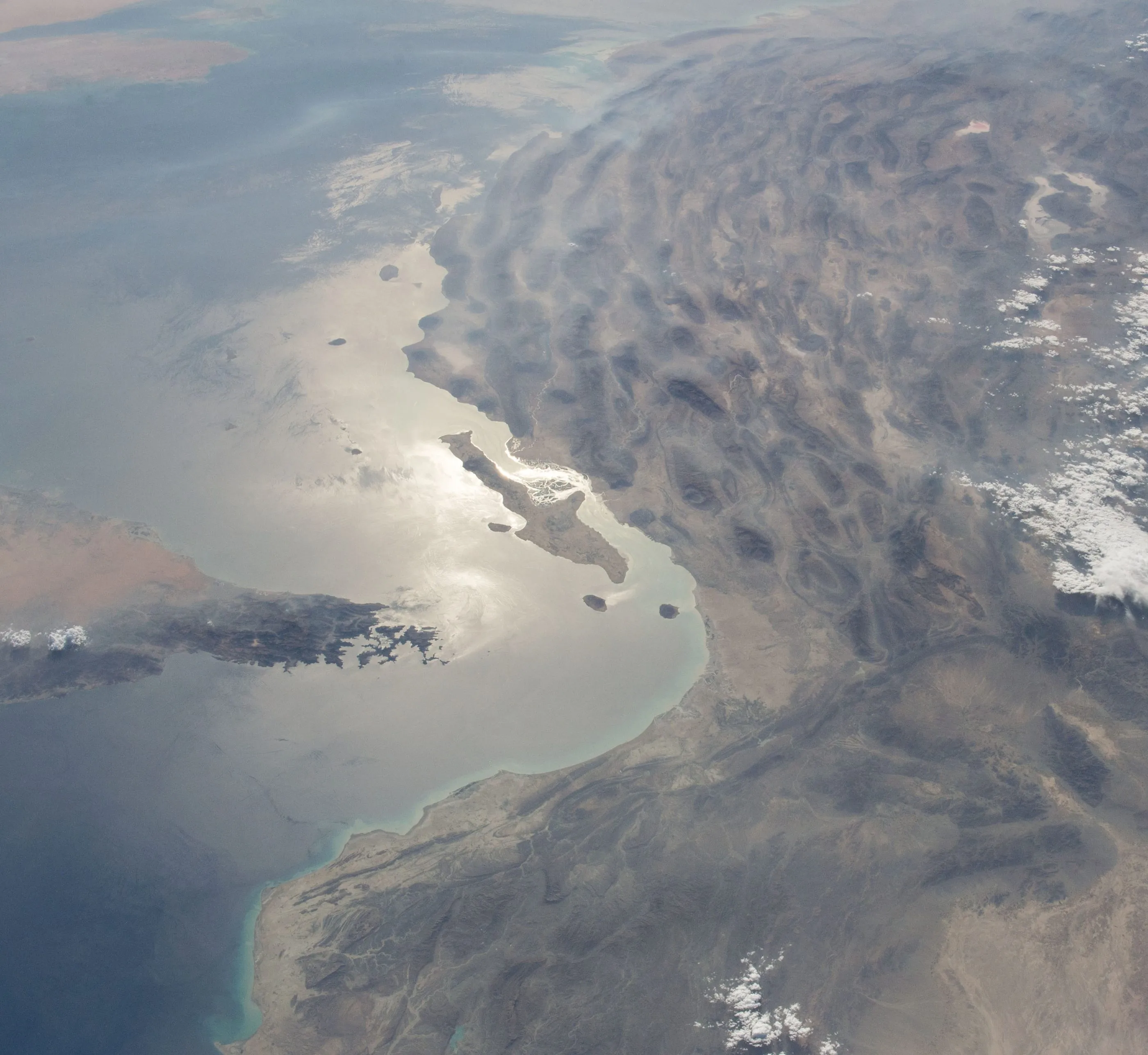
The Strait of Hormuz and the Musandam Peninsula from the International Space Station, June 2016. NASA Johnson Space Center, Public domain.
What is happening
Brent futures, settlement$109.86/bbl, highest close since mid-May. The NationalHormuz transits in seven days (UKMTO)254, about 70% below pre-conflict levels; 212 of them US-reported and unverified. UKMTO weekly report, via gCaptain The war is in its eighth month, and the Strait of Hormuz is open but contested. Brent futures
settled at $109.86 a barrel on 16 October, the highest close since mid-May. In the seven days to 14
October, UK Maritime Trade Operations (UKMTO) counted 254 transits through Hormuz, about 70% below
pre-conflict levels. It could not verify 212 of them, which were reported by the US. Ships are still
being struck by projectiles that the authorities have not identified.
US forces launched Operation Epic Fury against Iran on 28 February. Washington says it acts in the
collective self-defence of Israel, and that it aims to destroy Iran’s missiles and navy and to
ensure Iran never has nuclear weapons. Iran struck back at Gulf energy: Qatar lost 17% of its
liquefied natural gas (LNG) export capacity for three to five years. A two-week ceasefire mediated
by Pakistan began on 8 April. Talks in Pakistan then failed, and the US imposed a naval blockade. It
lifted the blockade in June, under an agreement to pause military operations, and reimposed it on
Iranian ports on 14 July. Tehran insists on controlling the waterway and says it will charge fees
for passage.
Gulf oil flows excluding Iran (Vortexa)Over 81% of pre-war levels (September average). Reuters, via gCaptainRefined products through Hormuz, seven-day average (Kpler)677,000 b/d (3.6 million before the war). Kpler, via CNBCSupertanker freight, Middle East to ChinaAbout $35/bbl ($3 in early 2026). JPMorgan, via RigzoneWholesale diesel, Europe and USAbout $220/bbl (over $200 in Singapore). IEA, via The National Crude has come back faster than fuel. Gulf oil flows excluding Iran reached over 81% of pre-war
levels in September, Vortexa data show; Iran’s own exports fell to zero under the blockade. Refined
products through Hormuz averaged 677,000 barrels a day in the week to 28 September, against 3.6
million before the war, according to the tanker tracker Kpler. The International Energy Agency (IEA)
says wholesale diesel reached about $220 a barrel in Europe and the US. Shipping costs have jumped:
JPMorgan puts supertanker freight from the Middle East to China at about $35 a barrel, from $3 in
early 2026. Our analysis reads physical Brent’s premium over futures as that shipping
bill. Iraq, whose main oil outlet is Hormuz,
devalued its currency by 13% on 7 October, and its crude leaves the strait on Iranian
permission.
Who controls the strait is disputed. US Central Command says the US does, and counts about 400 ships
in seven days without giving dates. UKMTO’s count is lower, and it says most attacked ships do not
report to it. Iran blamed a mine for the sinking of the container ship GFS Pride on 13 October;
Singapore reported unknown projectiles. Trump declared the last ceasefire over on 8 July.
Valtor’s inference Our reading, which is an inference: the market no longer prices a closed strait. It prices the
terms of passage, set by two sides that each claim control. Freight and diesel are where that
shows first.
Key figures
Each also stands in the margin beside the paragraph that states it.
$109.86/bbl, highest close since mid-MayBrent futures, settlement. The National
254, about 70% below pre-conflict levels; 212 of them US-reported and unverifiedHormuz transits in seven days (UKMTO). UKMTO weekly report, via gCaptain
Over 81% of pre-war levels (September average)Gulf oil flows excluding Iran (Vortexa). Reuters, via gCaptain
677,000 b/d (3.6 million before the war)Refined products through Hormuz, seven-day average (Kpler). Kpler, via CNBC
About $35/bbl ($3 in early 2026)Supertanker freight, Middle East to China. JPMorgan, via Rigzone
About $220/bbl (over $200 in Singapore)Wholesale diesel, Europe and US. IEA, via The National
Timeline
US Central Command said the US controls the strait and about 400 ships crossed in seven days; UKMTO counted 254 transits in the week to 14 October and could not verify 212 of them. gCaptain
The Singapore-flagged container ship GFS Pride sank after a strike by what Singapore called unknown projectiles; Iran claimed, without evidence, that it hit a mine. gCaptain
G7 leaders announced a coordinated release of 100 million barrels through the IEA over four months, with diesel first. Élysée, G7 Leaders' Statement
Drone attacks launched from Iraq halted Saudi Arabia's East-West pipeline, the export route that bypasses Hormuz. Bloomberg, via Rigzone
The US blockade of Iranian ports resumed on Trump's orders. CBS News, via WDEF
Trump said the ceasefire was over, after Iran struck at least three ships and US forces hit more than 80 targets in Iran. AFP, via The Defense Post
US Central Command lifted its blockade of Iranian ports under an agreement that suspended military operations during negotiations. Al Jazeera and the Associated Press
After talks in Pakistan failed, President Trump said the US Navy would blockade ships entering or leaving the Strait of Hormuz. CBS News
The US and Iran agreed a conditional two-week ceasefire, mediated by Pakistan, with shipping to be allowed through Hormuz. BBC News
QatarEnergy's chief executive said Iranian attacks had knocked out 17% of Qatar's LNG export capacity for three to five years. Reuters, via gCaptain
The IEA's 32 members agreed to release 400 million barrels from emergency stocks, with Hormuz exports at less than 10% of pre-conflict levels. International Energy Agency
US forces launched Operation Epic Fury against Iran, acting, Washington says, in the collective self-defence of Israel. US Department of State
The EIA's physical Brent price has stayed $20 to $26 above December futures since 5 October, after the gap doubled in a day. JPMorgan puts the cost of shipping a Gulf cargo to China at $35 a barrel, from $3 in January.
Crude volumes are near pre-war levels and futures sit near $106. Iran's attacks are being priced elsewhere: in record tanker rates, in discounts on Gulf crude and in ships that turn back before Fujairah.
The emergency release announced on 2 October is the undelivered part of the IEA's spring action, and much of it sits in Europe. The shortage it now has to fill is diesel, and Washington used the threat of an export ban to get it.
Qatar shipped 18 cargoes in six months against 509 a year earlier, and Europe enters winter short of gas. Henry Hub is no dearer than it was a year ago.
The US commander says the main routes are free of mines. JMIC counted 101 escorted transits in three days and kept the threat level at SEVERE. Brent sits near a six-month high.
Morgan Stanley put Middle East crude exports at around 17 million barrels a day last week. Brent still rose, after Houthi strikes reached eastern Saudi Arabia.
Total US crude inventories dropped to 695.2 million barrels, their lowest in 43 years. Commercial stocks drew 3.1 million barrels, the SPR fell again, and exports dropped 1.13 million barrels a day.
Dated Brent traded near $117 on 19 October, about $7.50 above December futures. A week earlier the gap was roughly $26. Gulf of Oman supertanker rates fell about 8%.
The Baltic's Gulf-to-China supertanker rate now earns about $1.4 million a day, half a million above the Gulf of Oman route outside the strait. From 26 October a London court is due to hear whether it reflects a real market.
ENTSOG's reference case ends the winter with storage 29% full. That requires LNG at the best pace of the past five winters with Qatar mostly absent. With 20% less LNG, the figure is 13%, and TTF is at its highest since 2022.
The East-West line is back near capacity and Riyadh plans more. The crude it carries for export still has to leave through Yanbu, which was hit by an unclaimed projectile on 1 October and targeted by a ballistic missile on 16 October.
Baghdad cut the dinar by about 13% on 7 October, the first devaluation by a Gulf Arab state since the war began. A price boom does little for an exporter that cannot ship.