Analysis, 5 min read
Physical Brent still sells $20 above futures. The premium is a shipping bill.
The EIA's physical Brent price has stayed $20 to $26 above December futures since 5 October, after the gap doubled in a day. JPMorgan puts the cost of shipping a Gulf cargo to China at $35 a barrel, from $3 in January.
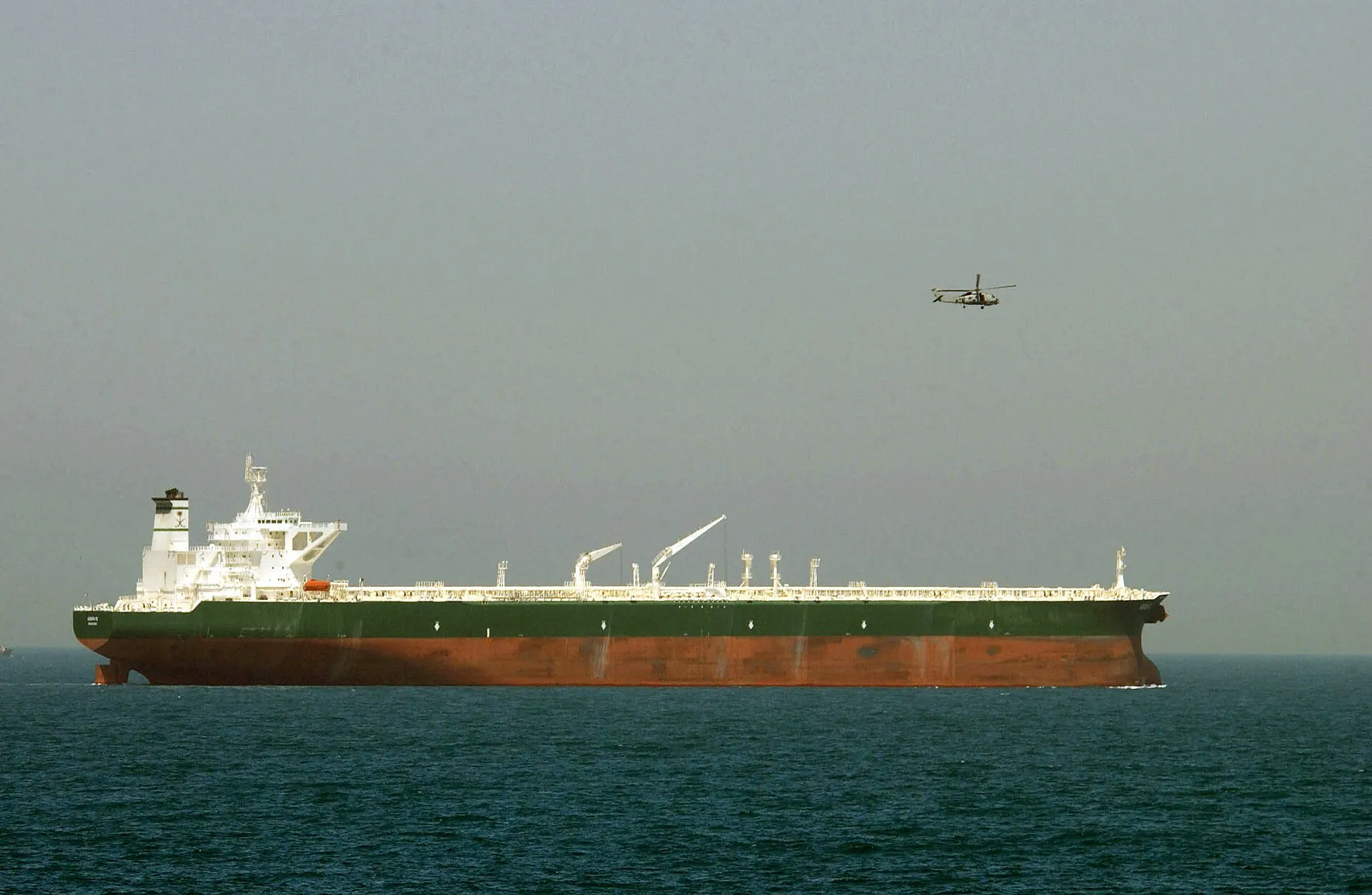
A Seahawk helicopter escorts the supertanker AbQaiq in the Gulf, June 2003. U.S. Navy, PH1 Kevin H. Tierney, Public domain.
Brent spot, physical (EIA) $126.55/bbl ($114.82 on 1 Oct, $135.51 on 2 Oct) . EIA via FRED Brent futures, December (ICE) $106.06/bbl ($102.31 on 1 Oct) . Bloomberg, via Rigzone Physical minus December future $20.49/bbl ($12.51 on 1 Oct, $33.26 on 2 Oct) . Valtor calculation from EIA and Bloomberg VLCC freight, Middle East to China About $35/bbl ($3 in early 2026) . JPMorgan, via Rigzone On 14 October the EIA’s spot price for physical Brent was $126.55 a barrel. The December Brent future settled at $106.06. The gap, $20.49, has not closed since it opened on 2 October. On 1 October it was $12.51. Over the same weeks, JPMorgan estimated, the cost of shipping a supertanker cargo from the Middle East to China rose to around $35 a barrel, against $3 early in the year.
What happened
The two prices split on 2 October. Physical Brent rose $20.69 that day to $135.51, while December futures slipped to $102.25. We found no report that explains the move. Since then the EIA price has held between $125 and $131, and futures have climbed from about $100 to about $106. Bloomberg’s own physical benchmark, Dated Brent, “topped $135” on 8 October, “the highest since April”.
Volume is no longer the main constraint. “About 12 million barrels a day of crude have exited the strait over the past seven to 10 days,” Vitol’s chief executive, Russell Hardy, said on 6 October. JPMorgan puts flows at 12 million barrels a day in September, up from about 7.5 million in July and August. Kpler had 13.5 million on a seven-day basis on 28 September. The counts differ by source and method. The risk has not gone either: UK Maritime Trade Operations reported at least nine attacks in the strait in the first week of October, half of September’s total for Hormuz and the Gulf combined.
The numbers
Physical Brent minus the December future, on EIA spot prices and Bloomberg’s reported settlements:
- 1 October: $12.51
- 2 October: $33.26
- 5 October: $25.19
- 6 October: $24.86
- 7 October: $25.80
- 8 October: $25.90
- 12 October: $23.30
- 13 October: $20.09
- 14 October: $20.49
Bloomberg gave 9 October’s settlement only as “around $104.72”, so that day is left out.
Freight moved further. The assessed supertanker rate from the Persian Gulf to East Asia reached nearly $1.4 million a day on 7 October, Bloomberg reported, “a surge of almost 540% since before the war, compared with an increase of about 40% in Brent oil over the period”. JPMorgan puts US Gulf Coast to China at $41 a barrel, from $6 before the war. “In effect, buyers are now paying upwards of $30 per barrel simply to transport crude to its destination,” the bank wrote.
Ships are the constraint. On JPMorgan’s count 766 of the world’s 923 very large crude carriers were in use in September, and about 124 Iranian VLCCs are effectively unavailable because of the US blockade and sanctions. Ship-to-ship transfers “can take up to 10 days”. Moving Middle Eastern crude, excluding Iran’s, now takes 35 more VLCCs than the 2025 average.
At the source, crude is getting cheaper. Saudi Aramco cut Arab Light for Asian buyers to $5 below the regional benchmark for November, a six-year low. Bloomberg tied the freight squeeze to the benchmarks directly: in West Africa, barrels that often sail to Asia “are trading at steep discounts, while the Dated Brent benchmark in Europe is near $130 a barrel as European refiners clamor for the most local supplies they can find”.
Transmission
JPMorgan puts the change in one line: “In April, the problem was a shortage of crude. In October, it is the cost of moving it.” In April, the bank adds, “the market was paying a premium for scarce barrels. Today, it is paying a premium to move them.”
Valtor’s inference Our reading, which is an inference: the gap between physical Brent and the December future is now mostly a price of distance. A North Sea cargo reaches a European refinery without a long voyage. When long-haul freight costs $30 a barrel or more, a cargo that needs no supertanker is worth much of that to a refiner nearby. The December contract prices later delivery and carries less of today’s shipping squeeze.
The cost lands on buyers far from their supply. For a refiner in China, JPMorgan puts the delivered cost of a Middle Eastern barrel at around $143, against $126 for Brazilian crude. Producers far from their buyers pay too: Aramco is cutting its price to keep Asian customers. Tanker owners collect.
There is a ceiling, and JPMorgan names it. Refiners pay for freight only while product margins cover it. “Record-high product cracks have so far provided an unusually large cushion,” the bank wrote, but North-west European hydro-skimming margins “have fallen sharply”, a sign that refiners are “once again struggling to pass rising crude acquisition costs through to product prices”.
The first sign of easing
Freight has started to come off its peak. Supertanker rates from the Gulf of Oman to China fell to about 776 on the Worldscale basis this week, from a record 841 the week before, according to Baltic Exchange data reported by Reuters on 16 October. Kpler’s Matthew Wright said demand on the route “has softened since the fresh attacks”, as higher freight and lower export volumes cut demand. Sparta Commodities’ Michael Ryan pointed to US comments about easing sanctions on some shadow-fleet tankers, which would add ships. “Despite the drop, rates remain close to record highs,” Reuters wrote.
Valtor’s inference Our reading, which is an inference: the premium narrowed from about $26 on 8 October to about $20 on 13 and 14 October, the same week freight came off its record. No source links the two moves, and a week is too short to prove it. It is what the shipping-bill reading predicts.
What to watch
- The EIA’s next spot prices, due 21 October. A gap of $20 or more over the December future would mean the freight squeeze is still setting the physical price. A return toward the $12 of 1 October would mean it is easing.
- Supertanker rates from the Gulf to East Asia. On our reading, further falls from Worldscale 776 should narrow the physical premium before they move futures.
- European refining margins. If they weaken, JPMorgan expects charterers’ willingness to pay for transport to “fall sharply”, which would hit freight and the premium together.
Bottom line
Futures near $106 and physical Brent near $126 are not in contradiction. On our reading they price different things: the future prices the oil, and the premium prices getting it to a refinery in time. For now the ships are scarcer than the crude, and the refiners’ margins decide how long buyers keep paying for them.
Figures in this piece
Each also stands in the margin beside the paragraph that states it.
- $126.55/bbl ($114.82 on 1 Oct, $135.51 on 2 Oct)Brent spot, physical (EIA). EIA via FRED
- $106.06/bbl ($102.31 on 1 Oct)Brent futures, December (ICE). Bloomberg, via Rigzone
- $20.49/bbl ($12.51 on 1 Oct, $33.26 on 2 Oct)Physical minus December future. Valtor calculation from EIA and Bloomberg
- About $35/bbl ($3 in early 2026)VLCC freight, Middle East to China. JPMorgan, via Rigzone
Sources
- EIA, Europe Brent Spot Price FOB, via FRED (DCOILBRENTEU), data to 14 October 2026
- EIA, spot prices for crude oil and petroleum products (release of 15 October 2026)
- Bloomberg, oil jumps on renewed conflict fears, 1 October 2026 (via Rigzone)
- Bloomberg, oil falls as G7 taps emergency supplies, 2 October 2026 (via Rigzone)
- Bloomberg, oil slides on Saudi price cut, 5 October 2026 (via Rigzone)
- Bloomberg, oil steady as Middle East exports rise, 6 October 2026 (via Rigzone)
- Bloomberg, oil dips as Middle East flows recover, 7 October 2026 (via Rigzone)
- Bloomberg, oil surges as Iran tanker attacks escalate, 8 October 2026 (via Rigzone)
- Bloomberg, supertankers racing to Middle East worsen ship crunch, 8 October 2026 (via Rigzone)
- Bloomberg, oil advances amid war and hurricane risks, 9 October 2026 (via Rigzone)
- Bloomberg, Brent tops $106 as supply risks intensify, 12 October 2026 (via Rigzone)
- Bloomberg, Brent steady amid Middle East tensions, 13 October 2026 (via Rigzone)
- Bloomberg, oil gains as global supply risks mount, 14 October 2026 (via Rigzone)
- Rigzone, October is beginning to look a lot like April for oil (JPMorgan report), 13 October 2026
- Reuters, supertanker rates fall from record highs, 16 October 2026 (via gCaptain)
- CNBC, Crude oil exports through the Strait of Hormuz hit prewar levels, but fuel shipments remain constrained (Kpler data), 30 September 2026
Filed under Iran war.
A number here looks wrong? Send a correction. How corrections are handled.
Get it by email
New analysis and notes, at most once a week. The address is used for nothing else, and one reply takes you off the list. Privacy notice.