Note, 3 min read
Reports say Middle East crude exports are back above pre-war levels. Brent hit its highest since May anyway.
Morgan Stanley put Middle East crude exports at around 17 million barrels a day last week. Brent still rose, after Houthi strikes reached eastern Saudi Arabia.
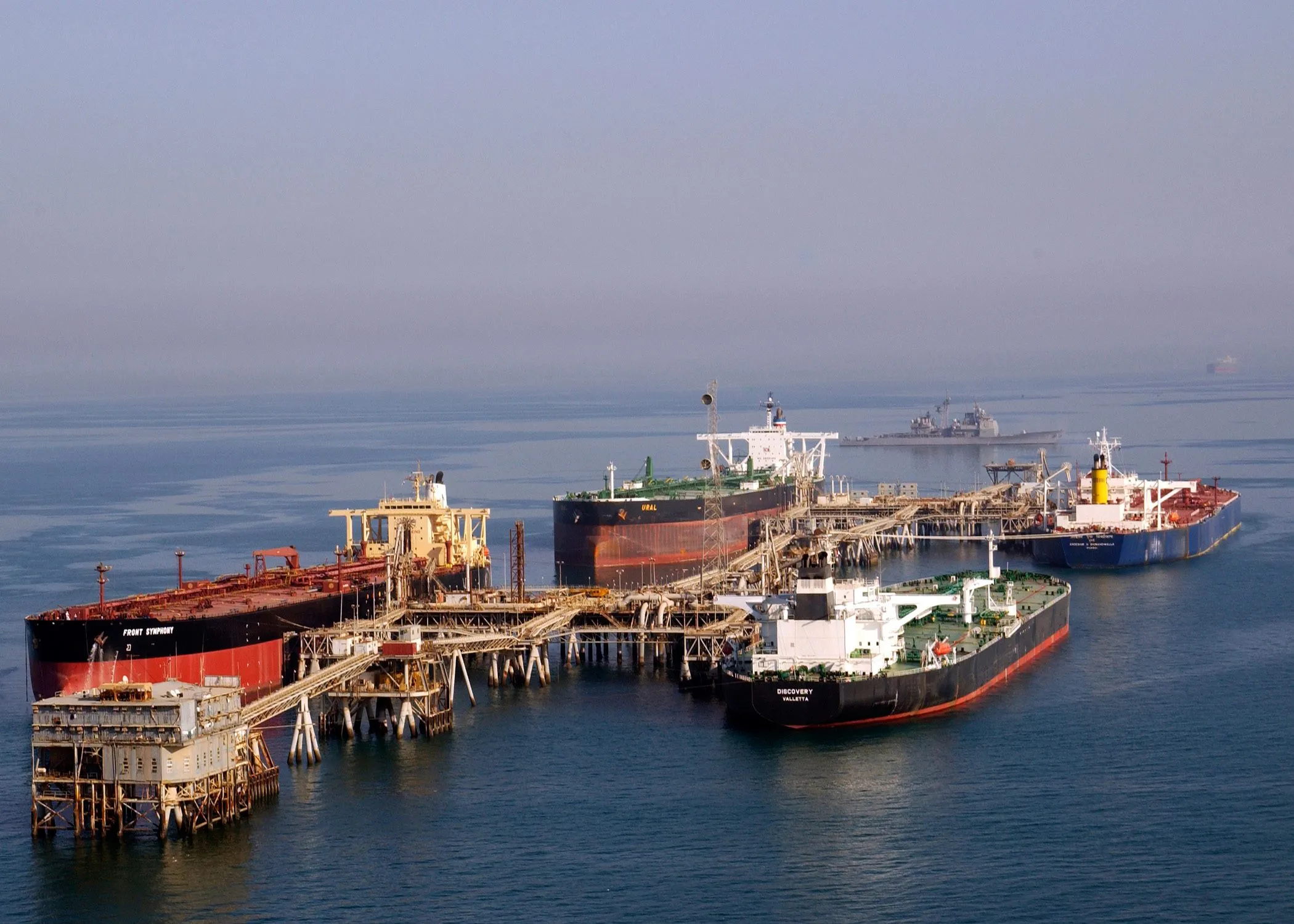
Tankers load at Iraq's Al Basra Oil Terminal in the northern Gulf, September 2004. U.S. Navy, PH2 Samuel W. Shavers, Public domain.
Reports say Middle East crude exports have returned above pre-conflict levels. Brent rose to its highest since May anyway. The rise came in the same days as Houthi strikes on Saudi Arabia.
What happened
Brent crude futures, intraday high $112.68 a barrel, highest since 18 May (afternoon price $112.01) . Reuters (via RTÉ) Brent price, Friday session $114.40, up $1.21; on track for a third weekly gain (price provider not named) . IBTimes Australia On 22 October, Brent futures hit $112.68 a barrel, the highest since 18 May. They traded at $112.01 in the afternoon, up $3.19 or 2.9%, per Reuters. Reuters attributed the rise to “more Houthi attacks in Saudi Arabia”. On Friday 23 October, IBTimes reported Brent at $114.40 and on track for a third weekly gain.
Brent settlement Near $101 a barrel . Bloomberg (via Rigzone) Compare 6 October. Brent settled near $101 that day, Bloomberg reported, as traders weighed rising Middle East exports against tanker risks. Since then, exports have been reported above pre-conflict levels, and the price is higher.
What the sources say
Middle East crude oil exports, Morgan Stanley estimate Around 17 million barrels per day, last week, per note reported on 22 Oct . Reuters (via RTÉ) The export reports carry few numbers. Morgan Stanley analysts estimated in a note that Middle East crude exports were around 17 million barrels per day last week. The sources give no pre-war baseline, so we cannot check the “above pre-conflict” claim ourselves.
The risk side is better documented. The Houthis struck several targets in Saudi Arabia on 21 October, Reuters reported. Saudi civil aviation authorities said one person was killed and eight injured at King Fahd International Airport in eastern Saudi Arabia, per IBTimes. Reuters reported two people killed in a drone attack on a Saudi oil field. It did not name the field. IBTimes reported that a drone aimed at an Aramco facility at Shaybah was intercepted. Analysts quoted by IBTimes said the attacks suggested the Houthis can now strike “deeper into Saudi Arabia, beyond their earlier focus on the Red Sea and the kingdom’s western ports.”
Six people with knowledge of the matter told Reuters that Saudi Aramco instructed staff to evacuate its headquarters in Dhahran, in the Eastern Province, and work remotely. They are anonymous. US officials told Reuters the State Department ordered some diplomats and family members to leave its missions in Saudi Arabia.
At sea, Iran’s Revolutionary Guard Navy said it hit four vessels in the northern Gulf and that three more hit mines west of the Strait of Hormuz. That is a claim, not independently verified. Iran’s state television reported tankers on fire or damaged in Hormuz. AP said that, if verified, it would be the largest number of vessels damaged in the waterway in a single day since the war began. That report is also unverified.
PVM Oil analyst Tamas Varga put the tension in one sentence: “Reports of Middle East crude oil exports exceeding pre-conflict levels are more than countered by attacks on ships in the Strait of Hormuz and the Houthi strikes on Saudi Arabia and on its oil infrastructure.”
Valtor’s inference Our reading, which is an inference: the market is pricing risk to where the barrels come from, not a shortfall in barrels shipped. Reports of rising exports came alongside a higher Brent. What changed in that window is that the Houthi strikes reached the Gulf side of the kingdom, the Eastern Province. A buyer who sees oil fields, an airport and Aramco’s headquarters under threat prices the next weeks, not last week’s loadings. We tracked the kingdom’s other export route in Saudi Arabia’s bypass pipeline.
What to watch
- The next Morgan Stanley or other published estimate of Middle East crude exports: whether it holds near 17 million barrels per day while the strikes continue.
- Brent’s weekly close: whether the third consecutive weekly gain is confirmed at the close.
- Verification of the Hormuz vessel reports and the Aramco evacuation: whether Reuters, AP or official bodies confirm them, and whether further strikes hit Saudi oil infrastructure.
Figures in this piece
Each also stands in the margin beside the paragraph that states it.
- $112.68 a barrel, highest since 18 May (afternoon price $112.01)Brent crude futures, intraday high. Reuters (via RTÉ)
- Around 17 million barrels per day, last week, per note reported on 22 OctMiddle East crude oil exports, Morgan Stanley estimate. Reuters (via RTÉ)
- Near $101 a barrelBrent settlement. Bloomberg (via Rigzone)
- $114.40, up $1.21; on track for a third weekly gain (price provider not named)Brent price, Friday session. IBTimes Australia
Sources
- Reuters (via RTÉ), world oil prices and Middle East exports, 22 October 2026
- AP (via Transport Topics), oil prices and damaged tankers, 22 October 2026
- Bloomberg (via Rigzone), oil steady as Middle East exports rise, 6 October 2026
- IBTimes Australia, oil prices rise on Saudi attacks and Iran tensions, 23 October 2026
Filed under Red Sea, Iran war.
A number here looks wrong? Send a correction. How corrections are handled.
Get it by email
New analysis and notes, at most once a week. The address is used for nothing else, and one reply takes you off the list. Privacy notice.