Note, 3 min read
Physical Brent's premium over futures fell by two-thirds in a week. Supertanker rates fell 8%.
Dated Brent traded near $117 on 19 October, about $7.50 above December futures. A week earlier the gap was roughly $26. Gulf of Oman supertanker rates fell about 8%.
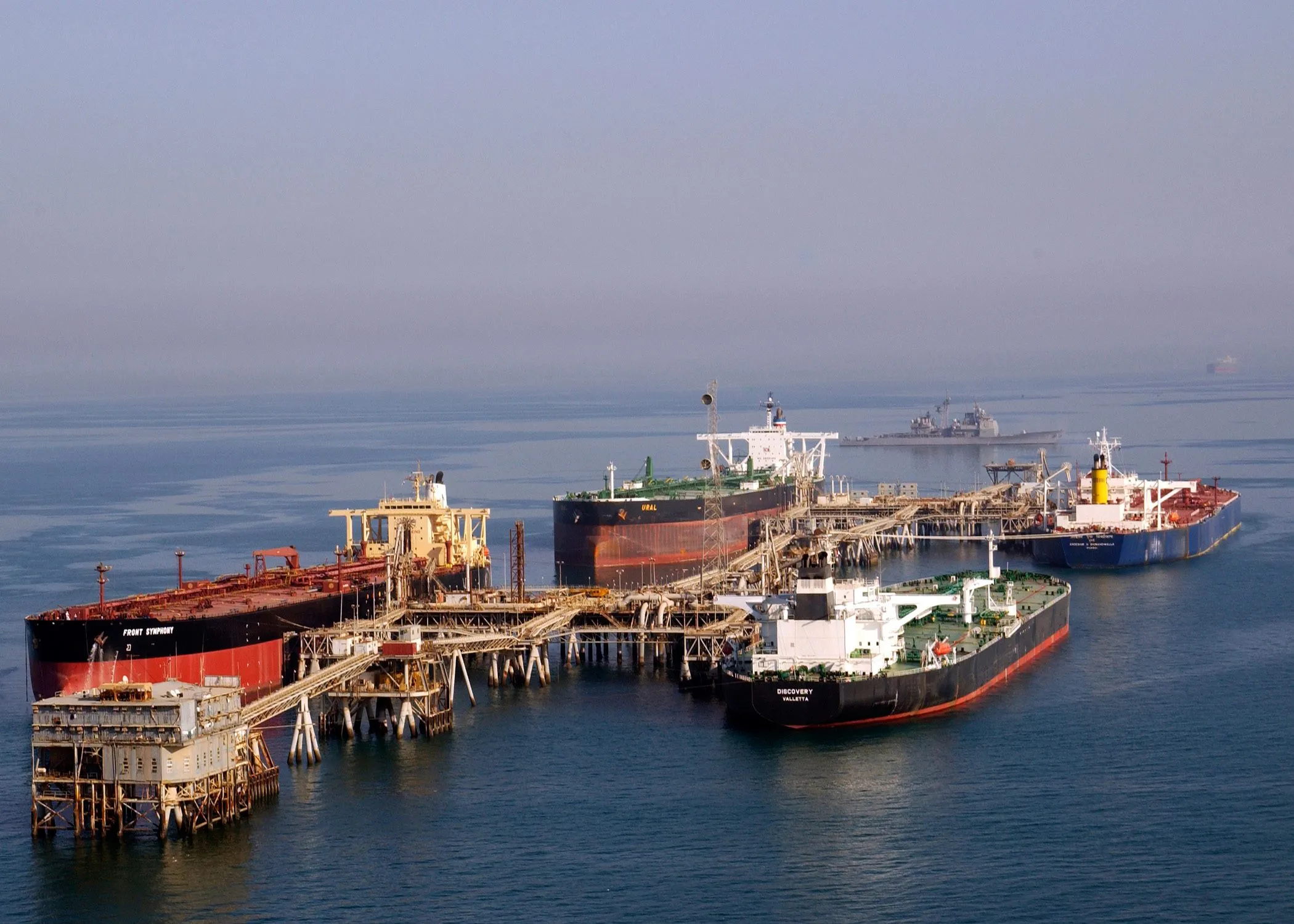
BP's refinery and tank farm at Europoort, Rotterdam, March 2014. Michielverbeek, CC BY-SA 3.0.
This note updates our 18 October analysis. That piece argued the premium of physical Brent over futures was mostly a freight bill. It named one signal for easing: a return toward the $12 gap of 1 October. The premium has now fallen sharply. Freight has not. The shipping-bill reading needs qualifying.
What happened
Dated Brent, Bloomberg assessment (down almost $16 on a week earlier) Near $117/bbl . Bloomberg, via Rigzone Brent futures, December settlement $109.55/bbl ($106.65 on 12 Oct) . Bloomberg, via Rigzone Bloomberg reported on 19 October that Dated Brent “traded near $117 on Monday, down almost $16 from a week prior”. December Brent “fell 0.3% to settle at $109.55 a barrel”. A week earlier it settled at $106.65.
Dated Brent minus December future (about $26 on 12 Oct) About $7.50/bbl . Valtor calculation from Bloomberg figures By our arithmetic, the gap between Dated Brent and the December future was about $7.50 on 19 October. A week earlier it was roughly $26. The gap shrank by about two-thirds or more while futures rose about $3. These figures are approximate, because Bloomberg gives Dated Brent as “near” and “almost”.
VLCC rate, Gulf of Oman to China (Worldscale) About 776, from 841 the week before . Baltic Exchange, via Reuters and gCaptain Freight moved far less. The Gulf of Oman to China supertanker rate fell to about 776 on the Worldscale basis from 841, Reuters reported on 16 October, citing Baltic Exchange data. By our arithmetic, that is a fall of about 8%. The 841 was the highest since the rate launched earlier this year. The windows differ slightly: the Dated Brent comparison is 12 to 19 October, the freight comparison is the week to 16 October. Inside the Gulf, the Baltic’s TD3C rate to China “climbed 115 points to WS1,318.75” in its weekly report published on 15 October, a round-trip TCE of $1,412,594 a day. That report does not state the week it covers.
One caution on sources. Bloomberg’s Dated Brent and the EIA spot series we used on 18 October are different assessments. We do not subtract one from the other. The EIA’s last reading was $126.55 on 14 October.
What the sources say
Bloomberg wrote that “physical markets show signs of loosening, with Hormuz flows holding up despite mounting threats”. US Energy Secretary Chris Wright told Fox News that Persian Gulf oil flows had recovered to about 80% of their pre-conflict level, though refined-product shipments remain constrained. Iraq has exported more than 3.4 million barrels a day so far this month, its oil minister said, close to pre-war levels.
Rebecca Babin of CIBC Private Wealth Group said: “More vessels are heading to China, flows continue through Hormuz despite escalating attacks, and Russia-Ukraine headlines are adding another layer of uncertainty.” She added that Friday’s fall in Dated Brent, “even as the paper market rallied”, shows “just how many crosscurrents traders are trying to navigate.”
Valtor’s inference Our reading, which is an inference: the Gulf of Oman rate eased about 8%, and the last TD3C print was a record, while the premium fell by about two-thirds. Freight alone does not explain that. Bloomberg and Babin point to flows, with more barrels leaving Hormuz and more ships heading to China. The premium was probably also paying for scarce nearby barrels, not only for distance. We cannot show causation from these sources, and one week of data is short.
What to watch
- The EIA spot release due 21 October. Compare it with the December future on the same day. A gap near the $12 of 1 October would confirm the easing in that series.
- The Baltic Exchange weekly report on 23 October. Check whether TD3C and TD34 fall further, or hold near record levels.
- Gulf export flows. Wright’s 80% figure and Iraq’s 3.4 million barrels a day are the markers to test against shipping data.
Figures in this piece
Each also stands in the margin beside the paragraph that states it.
- Near $117/bblDated Brent, Bloomberg assessment (down almost $16 on a week earlier). Bloomberg, via Rigzone
- $109.55/bbl ($106.65 on 12 Oct)Brent futures, December settlement. Bloomberg, via Rigzone
- About $7.50/bblDated Brent minus December future (about $26 on 12 Oct). Valtor calculation from Bloomberg figures
- About 776, from 841 the week beforeVLCC rate, Gulf of Oman to China (Worldscale). Baltic Exchange, via Reuters and gCaptain
Sources
- Bloomberg, oil prices hover near five-month high, 19 October 2026 (via Rigzone)
- Bloomberg, Brent tops $106 as supply risks intensify, 12 October 2026 (via Rigzone)
- Reuters, supertanker rates fall from record highs, 16 October 2026 (via gCaptain)
- Cyprus Shipping News, VLCCs climbing the record charts (Baltic Exchange weekly tanker report), 15 October 2026
- EIA, Europe Brent Spot Price FOB, via FRED (DCOILBRENTEU), data to 14 October 2026
Filed under Iran war.
A number here looks wrong? Send a correction. How corrections are handled.
Get it by email
New analysis and notes, at most once a week. The address is used for nothing else, and one reply takes you off the list. Privacy notice.