Analysis, 5 min read
Washington says it controls Hormuz. Gulf producers are paying for the passage anyway.
Crude volumes are near pre-war levels and futures sit near $106. Iran's attacks are being priced elsewhere: in record tanker rates, in discounts on Gulf crude and in ships that turn back before Fujairah.
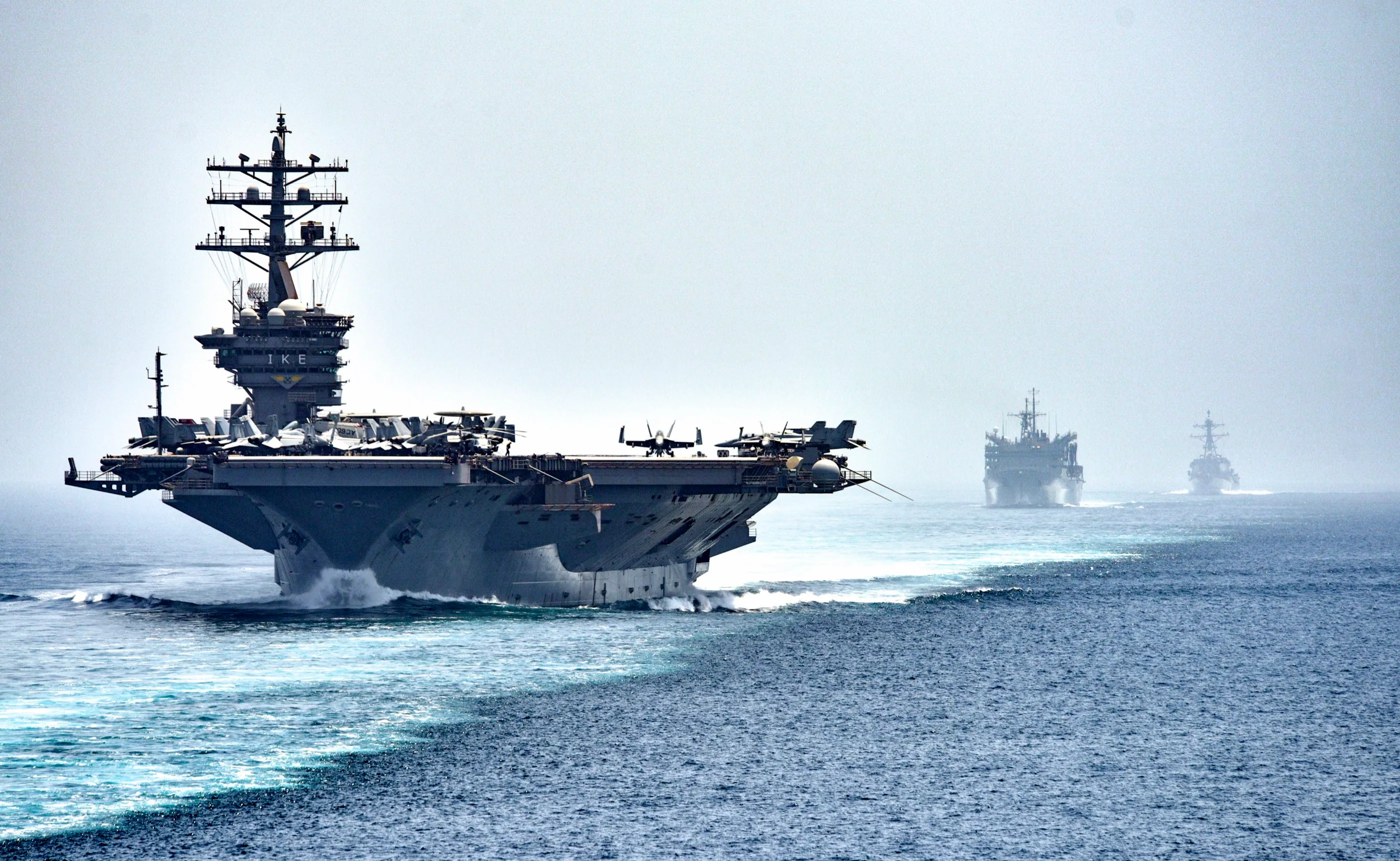
USS Dwight D. Eisenhower, USNS Arctic and USS Nitze transit the Strait of Hormuz, July 2016. U.S. Navy, Public domain.
On 13 October US Central Command said that “American forces and regional partners clearly control the Strait of Hormuz”, and that it had helped move more than 19 million barrels of crude through it the day before. The same day the Singapore-flagged container ship GFS Pride was struck in the strait. It sank; all 21 crew were evacuated. Both statements can be true. Washington’s control keeps oil moving. It does not make the passage cheap, and the cost of the passage is where Iran’s attacks are landing.
What happened
Attacks picked up as soon as traffic did. On 1 October the Kuwaiti supertanker Kazimah III was reportedly struck in the strait and caught fire. On 5 October Reuters reported that UKMTO had logged “at least one attack a day in the Strait of Hormuz or in the Gulf of Aden since October 2.” On 7 October a tanker was hit 51 nautical miles off Qatar, the first attack outside the strait since 9 September, according to Windward. On 11 October six ships were reported struck in one day, five tankers and a container ship, and the Joint Maritime Information Center kept its threat level at “SEVERE”.
Then came the container ships. The Maritime and Port Authority of Singapore said GFS Pride was hit by “unknown projectiles” on 13 October and GFS Giselle, from the same owner, the next day. Iran has claimed, without evidence, that GFS Pride struck a mine. Bloomberg’s tanker tracking, reported on 13 October, showed at least 10 supertankers and several Suezmaxes heading for Fujairah had “stopped or reversed course” in recent days.
The United States runs its own blockade at the other end. Central Command said on 10 October it had disabled a fourth commercial ship since resuming its blockade of Iranian ports on 14 July, and had turned back 135.
The numbers
Middle East crude exports, 7-day average 18.5 mb/d (pre-war average 18 mb/d) . Kpler, via Reuters On volume, the recovery is real. Kpler’s seven-day average of Middle East crude exports was 18.5 million barrels a day on 1 October, against a pre-war average of 18 million, Reuters reported. Vortexa puts September flows from the Gulf, excluding Iran, at 81% of pre-war levels: 91% for crude and condensate, 60% for refined products.
Hormuz transits, US Navy guidance data About 29 a day (about 138 historically) . JMIC, via gCaptain The way those barrels move is not. JMIC, citing US Navy shipping-guidance data, counted about 29 transits a day over 72 hours to 11 October, against a historical average of about 138, and noted that independent tracking saw “substantially fewer”. Near-normal volumes on a fraction of normal transits is what the shuttle of escorts and ship-to-ship transfers outside the strait looks like.
VLCC Middle East–China rate About $1.39m/day (about $60,000 average in 2025) . Bloomberg, via Rigzone Freight share of Gulf crude cost Over 25–30% (1–3% normally) . Windward The price of each load has exploded. Bloomberg put the cost of hiring a supertanker from the Middle East to China at “near $1.39 million a day” on 14 October. It averaged close to $60,000 a day last year. Bloomberg calculates the rise since before the war at “almost 540%”, against about 40% for Brent. Windward estimates that freight now accounts for more than “25-30% of the cost of the commodity” for Gulf crude, against 1–3% normally. Hormuz war-risk cover was quoted at 6–9% of a ship’s value in late September, the last figure we could find. Maersk now charges $1,000 per container on any ship that transits Hormuz.
Brent futures settled above $106 on 14 October. Dated Brent, the physical North Sea benchmark, was near $130 the day before, Bloomberg reported.
Transmission
The cost of the passage is not mainly showing up in the futures price. It shows up in three places.
Saudi Arab Light to Asia, November OSP $5 below benchmark, a six-year low . Bloomberg, via Rigzone The first is the seller’s price. Saudi Aramco cut Arab Light for Asian buyers in November to $5 below its benchmark, a six-year low, as Gulf producers “race for market share”. At the start of the war it charged a record $19.50 premium. Windward reports being told that national oil companies are paying tankers $50 million a transit to reach transfer points off Fujairah and Oman, and offering discounts of $35 a barrel off official prices. Those figures are unconfirmed, and we treat them as such.
The second is the ship. Shipowners willing to take the risk earn record rates. Those who are not, turn back: the empty VLCCs that stopped short of Fujairah are the shuttle system’s receiving end.
The third is the buyer’s route. Japanese-linked tankers, which avoided the region for seven months, have started loading there again, outside the strait: one supertanker took Omani crude at Mina al Fahal, and at least two more were expected at Fujairah, Bloomberg reported on 13 October. Hidenori Watanave of the University of Tokyo, who tracks the ships, told Bloomberg that lower costs are likely one driver, since direct loading avoids extra fees and delays.
Valtor’s inference This is Valtor’s inference, not a claim in any source. Iran does not need to close Hormuz to hurt its neighbours. It needs to make each crossing expensive and uncertain. On these numbers, the rent from Gulf oil is shifting from producers to shipowners and insurers, while the benchmark that headlines quote stays near $100. Iraq’s 13% devaluation on 7 October is one place that transfer has already surfaced.
What to watch
- Supertankers arriving at Fujairah. If the turn-backs Bloomberg tracked on 13 October persist for a second week, the ship-to-ship system loses receiving capacity and the volume recovery stalls.
- Saudi Arabia’s December official selling prices, due in early November. A discount wider than $5 for Asia would show producers absorbing more of the cost of passage.
- Container lines. A second sinking would test whether Maersk’s $1,000 surcharge, and Gulf container services in general, survive.
Bottom line
Washington has made Hormuz passable. Iran has made it expensive. The futures market prices the first; Gulf producers, through discounts, and shipowners, through record rates, are living the second.
Update, 18 October
Three things have moved since this was written. They sharpen the premise rather than change it.
- The control claim and the count diverged. On 16 October CENTCOM’s commander, Adm. Brad Cooper, said “the Strait of Hormuz is controlled by the United States and our regional partners, not Iran”, with about 400 merchant transits in the previous seven days. UKMTO’s weekly report counted 254 transits in the seven days to 14 October, about 70% below pre-conflict levels. Only 42 were seen on AIS. The other 212 came from US-reported facilitated transits, which UKMTO said “cannot currently be independently verified”. Cooper did not give the dates behind his figure.
- The attack count is a floor. UKMTO recorded 12 attacks in its latest period, 10 of them in the strait, and said most targeted ships are refusing to report to it. It knows of further incidents it cannot verify. On 17 October Iran’s Revolutionary Guards said two laden tankers had hit mines in the strait. Reuters reported no independent confirmation and named no ship.
- Freight came off its peak. Supertanker rates from the Gulf of Oman to China fell to about 776 on the Worldscale basis this week, from a record 841, Reuters reported from Baltic Exchange data. Kpler’s Matthew Wright put it down to softer demand on the route “since the fresh attacks”; Sparta’s Michael Ryan pointed to US talk of easing sanctions on some shadow-fleet tankers.
Valtor’s inference Our reading, which is an inference: a passage whose traffic cannot be verified and whose attacks go unreported is priced on the worst case. That is the cost this piece describes. A fall in freight on lower export volumes is not relief for producers. It is the passage pricing some barrels out.
Figures in this piece
Each also stands in the margin beside the paragraph that states it.
- About $1.39m/day (about $60,000 average in 2025)VLCC Middle East–China rate. Bloomberg, via Rigzone
- Over 25–30% (1–3% normally)Freight share of Gulf crude cost. Windward
- 18.5 mb/d (pre-war average 18 mb/d)Middle East crude exports, 7-day average. Kpler, via Reuters
- About 29 a day (about 138 historically)Hormuz transits, US Navy guidance data. JMIC, via gCaptain
- $5 below benchmark, a six-year lowSaudi Arab Light to Asia, November OSP. Bloomberg, via Rigzone
Sources
- Reuters, Middle East crude exports exceed pre-war levels but attacks increase, 5 October 2026 (via gCaptain)
- Reuters, Gulf oil flows rise to average 81% of pre-war rate in September, 6 October 2026 (via gCaptain)
- Windward, Tanker attacks spread beyond the Strait of Hormuz as Gulf freight costs soar, 8 October 2026
- gCaptain, More tankers hit in Hormuz as US strikes cargo ship, 11 October 2026
- gCaptain, New reports reveal five more ships hit near Hormuz, 12 October 2026
- Bloomberg, Supertankers turn from Gulf oil transfer hub amid Iran's attacks, 13 October 2026 (via gCaptain)
- gCaptain, Containership sinks as Hormuz attacks spiral out of control, 14 October 2026
- Bloomberg, Container ship sinks in Strait of Hormuz, 15 October 2026 (via Rigzone)
- Bloomberg, Oil gains as global supply risks mount, 14 October 2026 (via Rigzone)
- Bloomberg, Oil dips as Middle East flows recover, 7 October 2026 (via Rigzone)
- Bloomberg, Supertankers racing to Middle East worsen ship crunch, 8 October 2026 (via Rigzone)
- Bloomberg, Oil slides on Saudi price cut, 5 October 2026 (via Rigzone)
- Bloomberg, Oil carriers linked to Japan return to Mideast, 13 October 2026 (via Rigzone)
- Reuters, war risk premiums for Saudi-linked tankers, 25 September 2026 (via Insurance Journal)
- gCaptain, Fog of war deepens in Hormuz as UKMTO says most ship attacks go unreported, 16 October 2026
- Reuters, supertanker rates fall from record highs, 16 October 2026 (via gCaptain)
- Reuters, Iran's Guards say two tankers hit mines in Strait of Hormuz, 17 October 2026 (via gCaptain)
- Maersk, Middle East operational update, 7 October 2026
Filed under Iran war.
A number here looks wrong? Send a correction. How corrections are handled.
Get it by email
New analysis and notes, at most once a week. The address is used for nothing else, and one reply takes you off the list. Privacy notice.