Note, 2 min read
The benchmark that prices Hormuz freight goes on trial. It pays $500,000 a day more than the route next door.
The Baltic's Gulf-to-China supertanker rate now earns about $1.4 million a day, half a million above the Gulf of Oman route outside the strait. From 26 October a London court is due to hear whether it reflects a real market.
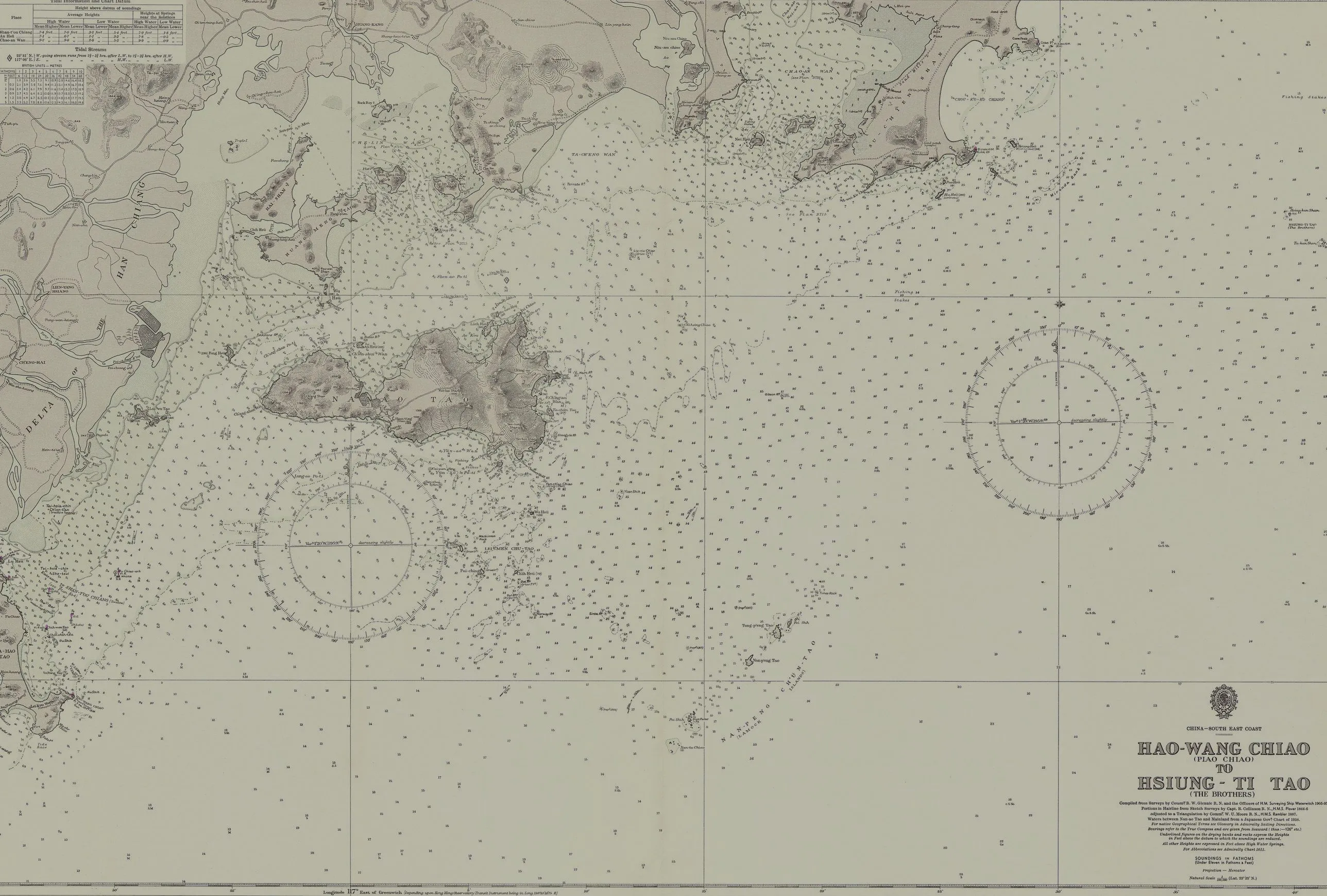
Admiralty Chart No. 1957, Hao-Wang Chiao to Hsiung-Ti Tao, on the Chinese side of the Taiwan Strait. Published 1934, new edition 1954. United Kingdom Hydrographic Office, Public domain.
TD3C, Middle East Gulf to China VLCC, Baltic weekly report published 15 Oct WS1,318.75; $1,412,594/day round-trip TCE Baltic Exchange, via Cyprus Shipping News TD34, Gulf of Oman to China VLCC, same report WS841.07; $912,660/day round-trip TCE Baltic Exchange, via Cyprus Shipping News TD3C is the Baltic Exchange’s rate for a 270,000-tonne supertanker from the Middle East Gulf to China. It is the number that freight derivatives settle against, and it is at a record. In the Baltic’s weekly tanker report published on 15 October, TD3C “climbed 115 points to WS1,318.75, which gives a daily round-trip TCE of $1,412,594”. TD34, the Baltic’s route from the Gulf of Oman to China, which loads outside the strait, stood at WS841.07, or $912,660 a day. The gap is about $500,000 a day.
The gap has widened as the rates have risen. On 11 September, Xinde Marine News reported, TD3C paid $862,150 a day and TD34 $465,764, a gap of almost $400,000.
Reported VLCC fixtures vs TD3C (about $1.035m/day on 14 Sep) $530,000-$603,000/day . Xinde Marine News, citing Baltic and Tankers International data The question is whether anyone is fixing ships at the TD3C level. On 14 September TD3C was about $1.035 million a day. Publicly reported fixtures late the previous week “were still in roughly the $530,000-$603,000-per-day range”, Xinde reported, citing Tankers International data. By our arithmetic, the index was 72% to 95% above those fixtures.
That is the case Mercuria brings to London. The Geneva trader sued the Baltic in April, arguing that “the benchmark ceased to reflect a functioning market” once Hormuz traffic largely stopped. Splash247 reported in May that Mercuria claims losses “running into hundreds of millions of dollars” on physical contracts and forward freight positions that settled against the index. The Baltic denies the claim. Judge Christopher Butcher fast-tracked a 15-day trial in the High Court, due to start on 26 October, citing “wider market concern”. No court has ruled on the merits.
Valtor’s inference Our reading, which is an inference: the $500,000 a day between TD3C and TD34 is the price the index puts on going inside the Gulf. It flows into forward freight settlements and into any cargo whose freight is indexed to TD3C. If the September fixtures are representative, much of that price is set by assessment rather than by trades. The trial will not change the war, but it could change what the war costs on paper. A ruling that TD3C should have been suspended, or referenced to TD34, would reopen every contract that settled against it since February.
What to watch
- The Baltic’s TD3C print in its weekly report on Friday 23 October, and the TD3C-TD34 gap.
- Whether the trial opens on 26 October.
- Reported VLCC fixtures out of the Gulf against the TD3C level.
Figures in this piece
Each also stands in the margin beside the paragraph that states it.
- WS1,318.75; $1,412,594/day round-trip TCETD3C, Middle East Gulf to China VLCC, Baltic weekly report published 15 OctBaltic Exchange, via Cyprus Shipping News
- WS841.07; $912,660/day round-trip TCETD34, Gulf of Oman to China VLCC, same reportBaltic Exchange, via Cyprus Shipping News
- $530,000-$603,000/dayReported VLCC fixtures vs TD3C (about $1.035m/day on 14 Sep). Xinde Marine News, citing Baltic and Tankers International data
Sources
- Cyprus Shipping News, VLCCs climbing the record charts (Baltic Exchange weekly tanker report), 15 October 2026
- Xinde Marine News, VLCCs top $1m a day, but what price is TD3C actually discovering?, 15 September 2026
- Splash247, Mercuria and Baltic Exchange set for fast-tracked Hormuz benchmark showdown, 28 May 2026
Filed under Iran war.
A number here looks wrong? Send a correction. How corrections are handled.
Get it by email
New analysis and notes, at most once a week. The address is used for nothing else, and one reply takes you off the list. Privacy notice.