Analysis, 6 min read
Saudi Arabia and the Houthis are at war. Container lines kept sailing back to Suez.
In the first fortnight of open fighting the missiles went to Saudi airports and oil sites, and the battle went to the Bab el-Mandeb coast. Container rates kept falling and the return to Suez grew.
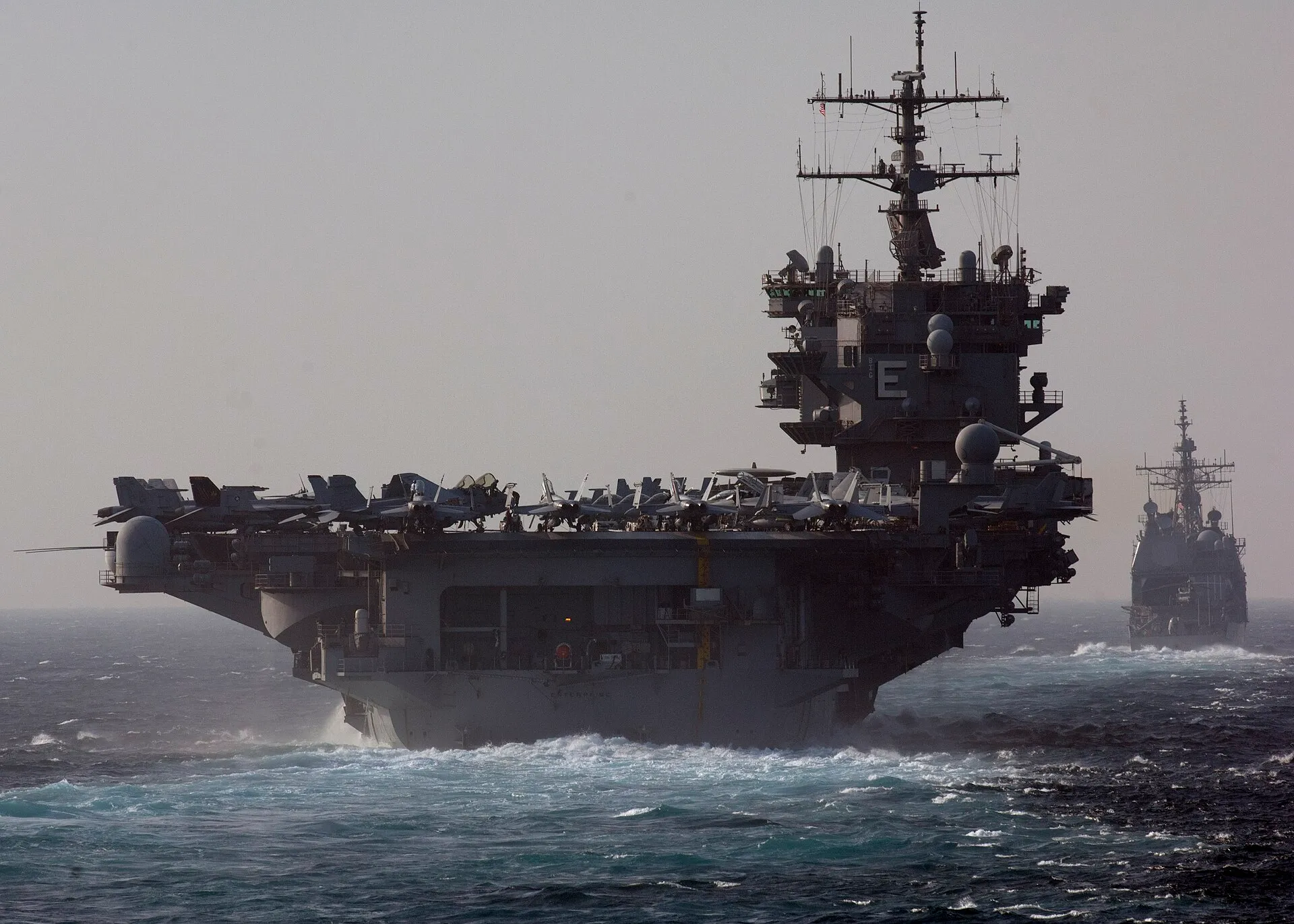
USS Enterprise and USS Vicksburg transit the Bab el-Mandeb, April 2012. U.S. Navy, MC3 Daniel J. Meshel, Public domain.
On Saturday 10 October a Houthi ballistic missile hit Riyadh’s airport and killed 13 people, by Reuters’ count, the deadliest strike in Saudi Arabia for a decade. Three days earlier, on 7 October, Maersk’s monthly market update said “four additional services” on its Gemini network were moving from the Cape of Good Hope to the Suez Canal. The update names no services; on 15 September Maersk and Hapag-Lloyd had announced four, AE5, AE11, AE12 and ME2. On 8 October, two days before the attack, Drewry’s container index fell 2%, and Drewry named the return to Suez as “the biggest threat to carrier efforts to support rates”. The war between Saudi Arabia and the Houthis has moved to the edge of the Bab el-Mandeb. So far the container market has not priced it.
What happened
The Houthis “swept down the Red Sea coast to the critical Bab el-Mandeb Strait” in September, Reuters reported. On Sunday 4 October Yemen’s internationally recognised government, armed and backed from the air by Saudi Arabia, launched an offensive to take the coast back. The next day its information minister, Moammar al-Eryani, told Reuters that government forces had secured effective control of the Bab el-Mandeb Strait. The Houthis called such claims “completely untrue”, and another government source said fighting continued at a base near the strait. By 13 October Reuters described the Houthis as pushed “off the area closest to the strait” but still “embedded nearby”, and gaining ground around Taiz.
The Houthis answered with missiles at Saudi airports for a week, including the strike on Riyadh. Bloomberg puts the toll from the weekend’s attacks higher, at “at least 16 people, including a US citizen”. On 13 October the Saudi-led coalition struck a fuel depot outside Sanaa. Its statement said the Houthis use sites in Sanaa, Hodeidah and Dhamar to “supply its arsenal of missiles and drones” for attacks on Saudi Arabia and commercial vessels in the Red Sea, Reuters reported. The Houthis named the Saudi Aramco headquarters in Dhahran and a Riyadh refinery as possible targets.
At sea, the fortnight produced one reported incident. On 4 October a tanker reported multiple explosions close to it 60 nautical miles south of Al Mukha, UKMTO said, as reported by Ship & Bunker. Nobody attributed it. In the sources we reviewed (Reuters, Bloomberg, Ship & Bunker, Freightos, Drewry and Windward’s incident reports) we found no individual attack on a merchant ship in the Red Sea or Gulf of Aden between 1 and 14 October. One line cuts the other way: Reuters reported on 5 October that UKMTO had logged “at least one attack a day in the Strait of Hormuz or in the Gulf of Aden since October 2”, without separating the two. UKMTO’s own incident pages could not be reached. On land the Houthis kept escalating: Bloomberg reported on 14 October that a strike had damaged about three floors of Saudi Aramco’s headquarters tower in Dhahran; oil production was not affected, a person familiar with the matter said.
The numbers
Drewry WCI composite $4,351/40ft, -2% w/w . Drewry Drewry WCI Shanghai–Rotterdam $3,337/40ft, -2%; 13th weekly fall Asia–Europe . Drewry Freightos Asia–N. Europe $3,260/FEU, -2–3% w/w . Freightos Drewry’s World Container Index fell 2% to $4,351 per 40ft container on 8 October. Shanghai to Rotterdam fell 2% to $3,337. Asia–Europe rates “have declined for 13 consecutive weeks”, Drewry said, and “increasing Suez Canal transits are adding capacity to the Asia–Europe trade, while uncertainty around Houthi activity remains.” Freightos had Asia–North Europe at $3,260 per FEU in its 6 October update, down 2–3% on the week.
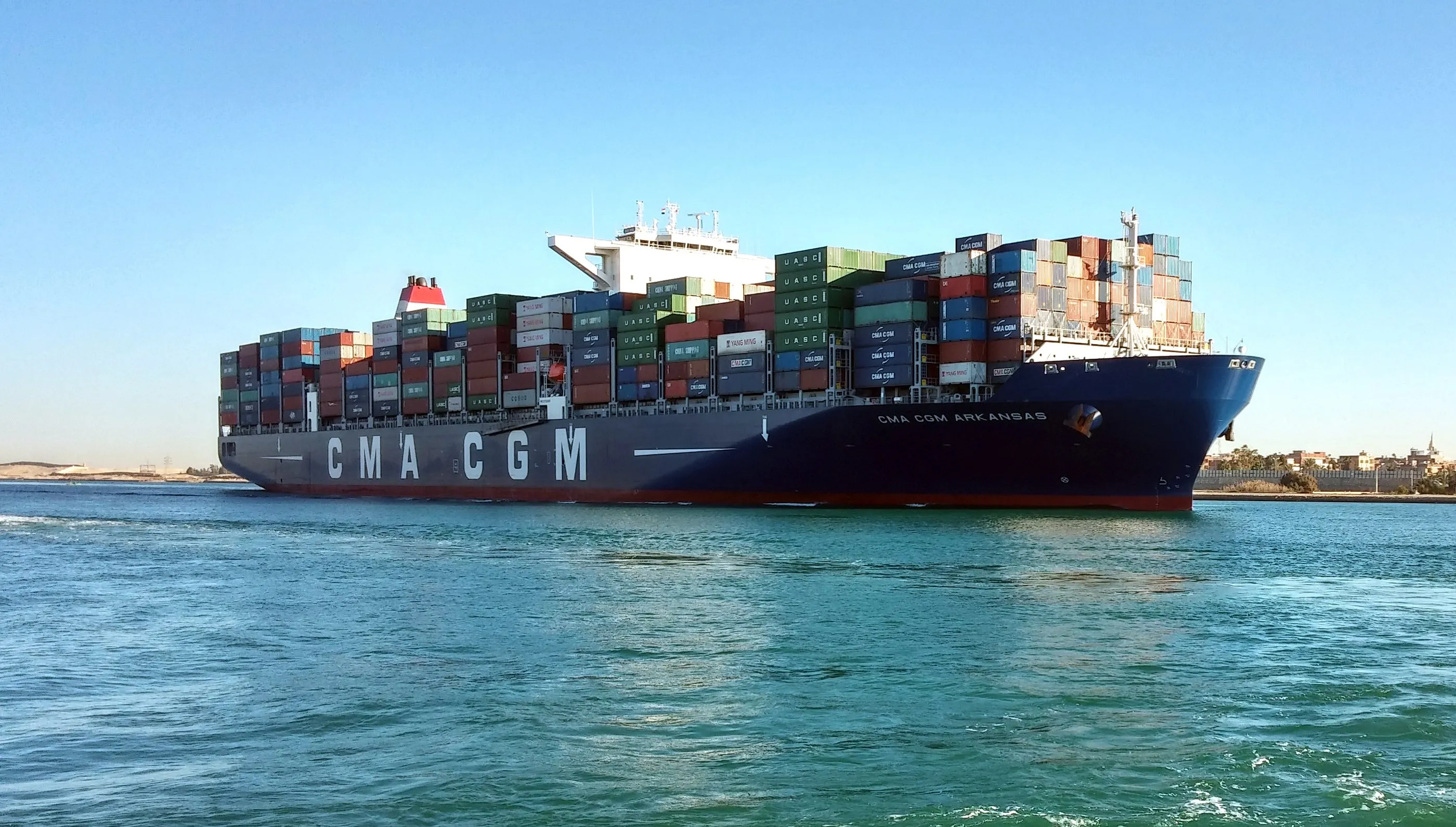
Large container ships through Suez, Jul–Sep 166 (16 a year earlier) . Suez Canal Authority, via Daily News Egypt The return is visible in the canal’s own numbers. The Suez Canal Authority counted 166 container ships of more than 130,000 tonnes through the canal between July and September, against 16 in the same quarter of 2025. CMA CGM described Suez on 13 October as a “permanent and sustainable route”, in Daily News Egypt’s account. Freightos reported on 6 October that the Premier Alliance, “the last holdout among the three alliances”, and MSC were resuming some Red Sea transits this month.
Rates are still high. Freightos says Asia–Europe prices remain above $3,000 per FEU on both main lanes, “about 70% higher than they were last year”. Asia–Mediterranean rose 7% to $3,800 per FEU in the week before Freightos’ 13 October update, after some carriers announced October increases.
Transmission
Freightos gives the direct reading. Red Sea transits are “one factor – with a post-peak season slide in demand the bigger factor” behind falling spot rates since July. It adds that the Saudi–Houthi escalation “may increase the likelihood of renewed Red Sea strikes”. Where the escalation did touch freight was in the air: missile attacks on Riyadh shut the airport, and “some foreign carriers” suspended services, though Saudi Arabia is not a major air cargo transhipment hub.
Valtor’s inference This is Valtor’s inference, not a claim in any source. On 1 October we described the carriers’ return to Suez as a bet on the Houthis’ declared target list, which named Saudi shipping only. The fortnight tested that bet and, on every individual incident report we could check, it held: the Houthis aimed at Saudi airports and oil sites, not at ships. The bet now also rests on the ground war. Reuters notes that a government-held coast would make it harder for the Houthis to disrupt shipping, but that “they could still target vessels with drones from positions further up the coast and inland.” The coalition’s own statement already counts commercial shipping among the Houthis’ targets.
There is a second reason carriers may keep sailing. Freightos notes that shippers and carriers “are now entering tendering season for 2027’s annual ocean contracts”. Each Suez routing adds effective capacity to a market already sliding into those talks.
Valtor’s inference One scenario, offered as speculation: if a non-Saudi ship is hit in the southern Red Sea during the tendering season, the routing decisions reverse fast, and the rate decline of the last 13 weeks becomes the base for a sharp rebound in Asia–Europe contracts.
What to watch
- UKMTO reports in the southern Red Sea. The first attack on a non-Saudi merchant ship would break the target-list premise that the return to Suez is built on.
- Drewry’s Shanghai–Rotterdam rate. Carriers plan higher FAK rates for the second half of October. A rise with no incident at sea means carrier pricing; a rise after an incident means risk.
- War-risk quotes for non-Saudi ships. The last Reuters figure, from 25 September, was 0.2–0.3% of a tanker’s value for ships with no Saudi connection. A move toward the Saudi-linked level of about 3% would come before any change in routing.
Bottom line
The war on the Red Sea’s eastern shore escalated sharply, and the container market kept falling. Our reading of the fortnight, on the reports we could check, is that this reflects where the missiles went, not complacency. The return to Suez is now hostage to two things: the Houthis keeping ships off their target list, and the government holding the coast it says it has taken.
Update, 17 October
Three things have moved since this was written. None of them breaks the premise.
- Rates turned. Drewry’s index rose 3% to $4,485 per 40ft container on 15 October, and Shanghai to Rotterdam rose 6% to $3,522. “After 13 consecutive weeks of decline, rates on the Asia-Europe trade route increased this week,” Drewry said. Carriers are trying to push Asia–Europe FAK rates to $4,500–$4,800 per 40ft from 19 October, it added, while “the resumption of Suez Canal transits” adds capacity. On the test we set above, a rise with no incident at sea reads as carrier pricing.
- The return grew. Container ship capacity through the Suez Canal averaged 753,000 TEU a week in the first two weeks of October, against 1,457,000 TEU in the same weeks of 2023, BIMCO reported on 14 October from Clarksons Research data. Since the Houthi attacks began, it said, “this is the first time that transits have exceeded 50% of pre-disruption levels.”
- The war came closer to the coast. On 16 October two missiles landed at Aden’s airport. Aden’s security department blamed the Houthis, who did not immediately claim responsibility. The Saudi-led coalition said it intercepted a ballistic missile headed for Yanbu, Saudi Arabia’s Red Sea crude export port, Reuters reported.
Figures in this piece
Those the text states in the same form also stand in the margin beside it.
- $4,351/40ft, -2% w/wDrewry WCI composite. Drewry
- $3,337/40ft, -2%; 13th weekly fall Asia–EuropeDrewry WCI Shanghai–Rotterdam. Drewry
- $3,260/FEU, -2–3% w/wFreightos Asia–N. Europe. Freightos
- 166 (16 a year earlier)Large container ships through Suez, Jul–Sep. Suez Canal Authority, via Daily News Egypt
- 4 more (AE5, AE11, AE12, ME2), first sailings from 19 SepGemini services moved back to Suez. Maersk and Hapag-Lloyd, via WorldCargo News
Sources
- Reuters, Saudi-backed forces claim control of Bab el-Mandeb Strait, 5 October 2026 (via gCaptain)
- Reuters, Saudi Arabia strikes Houthi targets as Red Sea war escalates, 13 October 2026 (via gCaptain)
- Ship & Bunker, UKMTO reports explosion close to vessel off Yemen, 5 October 2026
- Bloomberg, Brent steady amid Middle East tensions, 13 October 2026 (via Rigzone)
- Reuters, war risk premiums for Saudi-linked tankers, 25 September 2026 (via Insurance Journal)
- Reuters, Middle East crude oil exports exceed pre-war levels but attacks increase, 5 October 2026 (via gCaptain)
- Bloomberg, Aramco HQ hit as Houthis escalate attacks, 14 October 2026 (via Rigzone)
- Windward, Iran war situation room (incident reports; latest Red Sea item 17 September 2026)
- Maersk, Asia Pacific market update, October 2026 (7 October)
- WorldCargo News, Maersk, Hapag-Lloyd step up Suez routings, 15 September 2026
- Drewry, World Container Index, 8 October 2026
- Freightos, Premier Alliance joins Red Sea return, October 6, 2026 update
- Freightos, Attacks disrupt Saudi air cargo; China–Europe air rates slump, October 13, 2026 update
- Daily News Egypt, CMA CGM continues return to Suez Canal, 14 October 2026
- Drewry, World Container Index, 15 October 2026
- BIMCO, Suez Canal container ship transits exceed 50% of pre-disruption levels, 14 October 2026
- Reuters, missiles hit Aden airport, 17 October 2026 (via Jerusalem Post)
Filed under Red Sea.
A number here looks wrong? Send a correction. How corrections are handled.
Get it by email
New analysis and notes, at most once a week. The address is used for nothing else, and one reply takes you off the list. Privacy notice.